|
by Mark Fisher
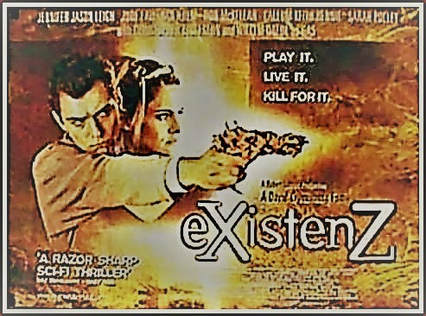
Pikul: I don't want to be here. We're stumbling around in the unformed world, not knowing what the rules are, or if there are any rules. We're under attack from forces that want to destroy us but that we don't understand.'
Watching Cronenberg's Existenz while teaching existentialism recently, I found myself finally persuaded of the director's claim that the film is 'existentialist propaganda'. Existenz has worn well, and repays re-viewing now. In retrospect, it is possible to position the movie as part of a rash of late 90s and early 00's films that can be seen as symptomatic expressions of the traumatic transition from the 'irrational exuberance' of the bubble economy to WoTerror. Along with Vanilla Sky, Mulholland Drive and The Matrix, Existenz' 'reality bleeds' anticipated the crashing into the US's simulated interiority of 'the desert of the real' on 9/11.
In a wonderful Zizekian shift, Existenz's Real is precisely not the empirical reality defended by the film's Realists (those committed to the destruction of the gamepods and the ontological contamination they threaten), but the Real of the cosmos as ongoing ateleological event: 'purposiveness without purpose' (Kant). The realists, by contrast, are those who treat whatever consensual hallucination they find themselves thrown into - and the random rules and protocols which make it liveable - as the only authorized reality.
Cronenberg: 'I'm talking about the existentialists, i.e. the game players, versus the realists. The deforming of reality is a criticism that has been levelled against all art, even religious icons, which has to do with man being made in God's image, so you can't make images of either. Art is a scary thing to a lot of people because it shakes your understanding of reality, or shapes it in ways that are socially unacceptable. As a card-carrying existentialist I think all reality is virtual. It's all invented. It's collaborative, so you need friends to help you create a reality. But it's not about what is real and what isn't.' (Sight and Sound interview).
Cronenberg's is a kind of ontological existentialism, then, in which the very nature of reality itself, not only the individual choices of subjects, is radically open. The Existenzialists precisely refuse what Nick Land in ''Meltdown'' called 'the dominator ur-myth that the nature of reality has already been decided.' Jude Law's Ted Pikul confronts the existential horror of abandonment, anguish and despair when he complains to Jennifer Jason Leigh's Allegra Geller (who at this time seems to be the designer of the very game, Existenz , that they are playing) that the game is without final purpose, that they are forever being accosted by malevolent forces intent upon their destruction. It's a game that would be hard to market, Pikul moans. And yet, as Geller tartly rejoins, it's the game that everyone is already playing.
The realists believe - or rather want to protect the self-delusion - that the particular world (=consensual hallucination) in which they find themselves is fixed and determined. What guarantees such fixity is of course the functioning of a transcendent designer - the game programmer, whose role is inevitably paralleled with what God does - or did - in/ for 'our' particular consensual hallucination. What Existenz demonstrates with admirable lucidity is that reality can only be authorized if it is authored - if, that is to say, its nature is controlled by an additional, allegedly 'more real' plane of reality, one level up from in which we find ourselves.
Thus Existenz turns on the Sartrean opposition between the in-itself and the for-itself. The players (Pikul and Geller) are for-itself, capable, or seemingly capable, of making choices, albeit within set parameters. (Unlike in the ludicrous Matrix, the players are constrained by the rules of the world into which they are thrown). The game characters are the in-itself, pre-programmed drones who can only respond to particular cues.
These in-itself pre-programmed game characters are one of the greatest sources of uncanny humour in Existenz. That's partly because their strange fugues and inability to act unless triggered by exactly the right stim are immediately reminiscent of so many interactions with 'real' human beings in late Kapitalism. In late Kapitalism, the experience of listening to a cheerful more-human-than-human robovoice announce, inevitably incorrectly, the arrivals and departures at a railway station and the experience of talking to a 'real live' call centre employee or ultra-trained estate agent, are all but indistinguishable. Professionalization = becoming as much like a bureaucratically controlled robozombie as is humanly possible. In none of these cases are there any signs of autonomy or ability to sensitively engage with either the situation or people around them. In the 'age of artificial stupidity' (Iain Hamilton Grant) , the tendency is for everyone and everything to be encouraged to act as if pre-programmed.
Taken from:
0 Comments
by Terence Blake 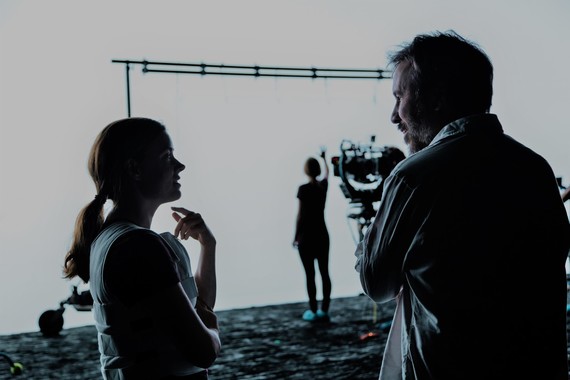 Denis Villeneuve’s ARRIVAL is a brilliant film, thoughtful and moving, visually powerful and emotionally rewarding. I cannot recommend this film too highly. However, just as his BLADE RUNNER 2049 differentiates itself from the original BLADE RUNNER by providing an explicitation of certain of its elements and themes, and even of its enigmas, Villeneuve’s ARRIVAL can be seen to modify Ted Chiang’s original novella STORY OF YOUR LIFE in order to render it more comprehensible. The novella deals with an alien race with a different conception of time, one that is based on apprehending causality as a synchronic array rather than as a diachronic sequence. The film tries to concretise this alien conception in terms of an alien perception of time, one that involves precognition. It is never stated in the novella that actual foreknowledge is obtained from learning the Heptapod language. The synchronic vision of our life may be “just” a consequence of retroactive apperception of meaning. Saying yes to the event involves affirmation of its consequences, both good and bad. This shift from synchronic conception to precognitive perception is useful to show how the alien language rewires the human brain and its vision of the world but the drawback is that it reintroduces linear causality in form of the use of inside information about the future to bring about a desired outcome. Whereas in the novella we never know why the aliens came, it seems to be just part of their existential fatality, in the film they come to gift us with their language and with it their precognition, because they have foreknowledge of a future time when they will need our help. This reintroduces a sort of egoism, and reduces the exchange to our linear model, making it a sort of insider dealing. In the novella there is an exchange between humans and aliens, but the Heptapods seem to have no idea of equivalence: each side gifts the other without a requirement of equal value. The only seemingly new “gift” of scientific knowledge, aside from their language (whose value seems more philosophical than practical) turns out to be a not yet widely publicised recent discovery. Villeneuve adds the “insider futures trading” aspect as a pragmatic repetition of the more epistemological linguistic exchange. This pedagogical explicitation does not necessarily betray the original story, but can be considered to fill in a gap, or to spell out an implicit motive. The aliens bring us something we needed, a linguistic vehicle for the revelation and assimilation of the Stoical, and Nietzschean, Eternal Recurrence. In return, they may need our linearity so that their own seemingly passive habitus of willing the event may be redoubled into active willing. The article is taken from: |
 RSS Feed
