This post has now been included in a broader piece on Anthrocene cinema, which is here.
Watching the previews for the summer movies, they all seem to me to belong to the genre of the Anthropocene. They all seem to be narratives about a civilization confronting limits of its own making. Some movies respond by stressing the glorious expenditure of energy, burning it up with images of fast cars, fast planes, fast women. And guns, lots of guns. Other opt for apocalypse. If the present cannot go on infinitely expanding then it can only collapse. No qualitative change can be imagined in narrative form. After us, the deluge: the Sun King’s prediction democratized. Edge of Tomorrow is an interesting variation. Yes, it’s a Tom Cruise action sci-fi concoction, but these are not without their charms. Tom’s face provides the machinic sheen against which robots and other otherwise all too techy images come to seem warm and somehow human. There’s a creepy shot of his right ear that keeps returning, again and again, with weird stretch marks, as if someone has shrouded a Mills grenade in cling-wrap. Setting Cruise aside, Edge of Tomorrow is interesting for a few reasons. The story’s mechanic is pure video game. Cruise and his co-star have the special property, bestowed on them accidentally by invading ‘aliens’, of starting the action over again, every time they die. Edge of Tomorrow lives out – and dies out – a desire for do-overs, for digital time. The time of the edit suite, as well as of the video game, where real time is not duration but measured and metered time. As if Bergson had it backwards, and pure duration were more an after-image of clock time and clock speed.
Edge of Tomorrow is about video game time, where death is not final, not an end, but rather a beginning, a do-over. Tom and his co-star do time over and over, trying to beat the aliens, clearing levels, backtracking out of dead-ends, all the way up to the boss level. But the time against which they fight is not duration, it is rather the historical time of the Anthropocene. It’s a human wave assault, by the most advanced flesh-tech of this civilization, against the very limits it has itself created.
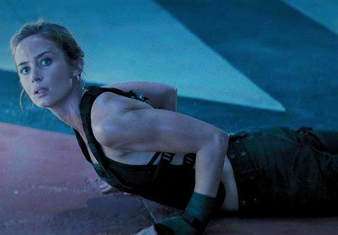
It is not an exaggeration to call this historical time one of civilization. The aliens have conquered Europe. Russia and China are holding it at bay. The decisive battle is a re-staging of D-day, across the English channel. The movie charmingly presents the Brits as nothing more than a front for American imperial power. But in a way all of the current variants of capitalism as a civilization confront the same enemy. It is of course unseemly to talk about civilizations. That whole language has belonged since its inception to the apologists of empire. So one has to imagine, when I use the word civilization, that I say it the way Charles Fourier would – pausing to spit in the middle of such a long and encumbered term. The fantasy, then, is that the digital time of this civilization – be it capitalism still, or something worse – has within its power the ability to overcome the almost shapeless, formless, seething tentacle menace. One which curiously seems to have some sort of mimetic power. It doubles us and confounds us. It erupts from the earth or out of the sea, or appears out of nowhere in the sky. Its an almost molecular enemy. It is techy, like us, and yet not. It is perhaps the shadow image of our own forces of production, mediating between earth and air and water, and bringing fire. It is very scary except in those moments when the film makers lose their nerve and give it a face. Tom and co-star alone confront this alien with the digital power of do-over time, getting beaten again and again, restarting the game each time. The co-star is Emily Blunt. She is the perfect embodiment of the weaponized woman. We see her tanned and oiled arms as she does push-ups in a black-ops chic sleeveless number, the camera lingering just a bit over her ass. The casting is a masterstroke. Blunt plays the global archetype of the stiff-upper-lip-Brit, mixed in with a bit of thorny English rose. The femme-gun doesn’t really do feelings. Blunt’s performance is so on-point that she makes Cruise seem almost human.
I won’t give away where they confront the boss alien, but it is in a landscape under water. Weird weather as a feature of a lot of movies of the Anthropocene. It can be caused by anything at all, except the emission of green house gases from the collective labors of this civilization. This is key. The cinema of the Anthropocene is about anything but the causes of the Anthropocene. But it is very candid about its effects.
So the boss-alien is confronted in old Europe, from which this civilization’s mode of production sprang. We see old Europe under water, as indeed in a way it already is, in the future already pre-set for it. Cruise and Blunt: perfect names for our heroes, for the two affects that dominate the action. And of course they win. There may be a point to this. If we could prefigure all of the permutations of the narrative resources of this civilization, run through them all, have all our futures over and done with in advance, we might be done with this whole narrative formation. Perhaps we need to play this game till we get bored with it. Perhaps we will get bored with it soon enough to discover that its digital time does not accord with the historical time of the Anthropocene. That other time is out there, like a formless alien.
0 Comments
Leave a Reply. |
 RSS Feed
