OnScenes
  • OnScenes
  • News
  • Art
    • Music >
      • Album Review
    • Poetry
    • Film >
      • Filmmakers >
        • Movies
    • Theater >
      • TheaterMakers
  • Philosophy
  • PhiloFiction
  • Science&Technology
  • Economy
  • Media
    • Video
    • Audio
  • About
  • Contact
    • Location

NIGHT TOWN (Part 2)

6/12/2017

0 Comments

 
by  Greg Olson ​
Picture
A rebel for the cause of unbridled free expression, Hopper stormed through life wolfing down booze and drugs, and romancing every starlet he could get his hands on. Hopper’s compulsion to maintain a militantly antiestablishment stance kept hurting his career: He couldn’t resist alienating the very people who could help him. He wrote, “Jimmy Dean once pulled a switchblade and threatened to murder his director. I follow his style in art and life.” Hopper’s former wife, Brooke Hayward, recalls, “We’d go to these parties where you’d have the crème de la crème of Hollywood, and he’d tell them that when he ran things heads were going to roll, they’d be in chains.”
Lynch calls the 1960s “the decade of change,” an era in which America was divided against itself: young against old, those who hated the Vietnam War against those who supported it, the counterculture against the establishment. While Lynch was painting in his studio, Dennis Hopper was walking with the Reverend Martin Luther King Jr. in the Alabama Freedom March for African American civil rights and being spat on by southern bigots who called him “a nigger-loving Communist.”
​Though Hopper’s mind was engulfed in drugs, rage, and paranoia, the excess and chaos of his life spawned the landmark American film Easy Rider, which he directed, co-starred in, and co-wrote. Made for only $350,000, the movie tapped into the archetypal American myth of the promise of the open road, which had been sung by everyone from the first explorers and pioneers to Walt Whitman, Mark Twain, John Steinbeck, and Jack Kerouac. (In 1990, Lynch would join the freedom-loving road chorus with Wild at Heart.) Unlike Lynch’s artwork, Easy Rider was consciously, overtly political, and it expressed the mindset of many baby boomer–generation youth who celebrated peace and free love and railed against the corporate warmongers who were napalming babies in the jungles of Vietnam. The film asks a wrenching question that haunts us today: How can each of us be free and make American the way we want it to be without hurting each other and trampling on each other’s freedom? 
Easy Rider made the brooding Hollywood outsider Dennis Hopper wealthy, famous, and instantly reclassified as “a creative genius.” His film changed the face of the movie business. Graying studio executives began catering to the “youth market” by hiring twenty-year-old “do-your-ownthing” filmmakers, and soon even the top-level-management ranks surged with younger blood. Hopper was given free reign to make his magnum opus, The Last Movie, a heavy-handed treatise against Hollywood/American imperialism presented in a boldly deconstructed narrative that turned off critics and audiences in droves. Hopper was once again exiled from Hollywood, and his professional and personal life spiraled down into drug addiction and psychotic hallucinations. 
Hopper was absolutely out of control, and his friends stepped in and got him into a detoxification program. Actor Dean Stockwell, whose career had been revitalized after he played the traitorous Dr. Yueh in Lynch’s Dune, was instrumental in helping his comrade stay clean and sober, one day at a time.
​Lynch had put Hopper on his first list of possible actors to play Frank Booth, but the director figured that if even half the stories about the legendary rebel and crazy man were true, he’d best leave him alone. Still, he’d heard that Hopper had cleaned up his act in recent months, that his searing talent was no longer compromised by scrambled brain chemistry. One day, the director’s phone rang, and Hopper’s intense voice declared, “I’ve got to play this part, David, because I am Frank.”37 Impressed and shaken by the actor’s unorthodox audition, Lynch said to the assembled cast and crew, “My God, he just told me that he is Frank. I don’t know what he meant by that. Maybe he’s right for the part, but how are we going to have lunch with him?” They decided to risk it. 
Once the world saw Blue Velvet and experienced the blast-furnace power, frightening, sadistic perversity, and commanding authenticity of Hopper’s Frank Booth, word got around about the actor having said “I am Frank,” and once again he had some explaining to do. “I understand Frank very well. I was known to abuse people when drunk or high, but not exactly in this way. I’ve also played a lot of sex games, but I’m more a masochist than a sadist.” For Brooke Hayward, Frank Booth’s behavior was a portrait of “the way you would have seen Dennis behaving” in the 1960s. 
​
Whatever the origin and history of the ferocity that Hopper brought to Frank Booth, Lynch was thrilled to have captured it with his camera. And Hopper was excited to be playing “perhaps the most vicious person who has ever been on the screen.” The actor credited Lynch with helping him reach his peak of frenzy: “David kept me up really high, pushing all the time. He insisted I keep playing it at a high level. I love what I do in the film, and I love what David did with me.” Hopper admitted that just a few months earlier that he “would have taken cocaine” to achieve his riveting acting effects, but now he was deeply gratified to be enjoying the sober life and drawing upon the pure, unadulterated streams of his talent. Lynch and company learned that having lunch with Dennis was no strain at all. 
Hopper’s old pal Dean Stockwell rounded out Blue Velvet’s cast as the flamingly suave drug dealer Ben, and Lynch completed his technical crew by bringing in his longtime friend and sound-design maestro Alan Splet. Isabella Rossellini’s Dorothy would have to sing a couple of nightclub numbers, so the director hired composer Angelo Badalamenti to coach her vocal performances. Lynch had such a positive rapport with the genial, rotund music man that he engaged Badalamenti to score the entire film, thus beginning a creative “marriage” that has included the director’s every movie, TV, and stage production through Mulholland Drive. Badalamenti wrote a beautiful melody to accompany Jeffrey and Sandy’s falling-in-love scene ​and Lynch was inspired to pen lyrics for it, thus opening up another avenue of self-expression that the director would pursue in the future. The resulting song, “Mysteries of Love,” needed just the right person to sing it, and the ethereal-voiced Julee Cruise was given the job, initiating still another of Lynch’s longtime artistic partnerships. 
After Dune’s ultimately frustrating and dispiriting three-and-a-half years of inflated gigantism, making Blue Velvet felt like an intimate homecoming to Lynch. As with Eraserhead, the director was working with a smallish budget and an extended family of friends and collaborators, and he knew that the vision that reached the screen would be his alone. He was regaining his creative confidence after the Dune debacle, as Kyle MacLachlan recalls, “David was able to say, ‘this Blue Velvet material comes from me; I’m going to trust that it’s right.’” Lynch’s Blue Velvet dream was unique, but, as with Dennis Hopper’s road-tripping Easy Rider, it tapped into a primal, potent American myth.
​For the country’s early, colonizing settlers, America was the frontier, a world of limitless space in which they could move about, build, worship as they pleased, and reap the bounty of their new land. Ordinary, common folks could chart their own course in this rural paradise, but as wave after wave of immigrants washed ashore and industrialized cities began to sprout, the frontier of wide-open promise and possibility kept elusively advancing westward. In 1890, newspapers from coat to coast delivered a traumatic shock to the American psyche: According to the latest census, the frontier was officially and forever closed. As more people jammed into cities, the urban areas expanded their boundaries and crowded out the wild, unsettled land. Cities pulsed to the oppressive beat of machines, and lived on a schedule of mechanized time, rather than the cycles of nature. An alfresco, neighbor-to-neighbor democracy was replaced by institutionalized government, blue skies became sooty gray, and the crime statistics worsened every year.
But there remained enclaves of rural hope and freedom, places that struck a perfect balance between the secure comforts of civilization and the spirited call of the wilderness. Small towns preserved the agrarian pursuits and free-ranging roots of the American experience. Sure, we’ve got cars and newfangled tractors and telephones, but in our hearts we know that the frontier starts right out where Maple Drive ends. The town grown-ups and kids all know each other, we leave our doors unlocked, and solve little problems in the front-porch twilight and tackle big ones at the town meetings. We jump right in to help in a crisis, but otherwise we let each other be. We’re a tight community of ruggedly individualistic souls, not a cheek ​by-jowl lonely crowd of strangers rat-racing after the almighty dollar in some skyscraper metropolis. Smelling fresh-cut wheat on the wind is more valuable than all the Mercedes-Benz exhaust fumes in the world.
In the American mind, there is a sun-dappled line of continuity that stretches from the earliest settlers’ idealized New England image of a village in the seventeenth-century wilderness; to Sarah Orne Jewett’s romanticized Tales of New England (1879); to Booth Tarkington’s The Gentleman from Indiana (1899), whose town is “one, big, jolly family”; to Thornton Wilder’s Our Town (1938); to the Andy Hardy movies of the 1930s and 1940s; to William Saroyan’s The Human Comedy (1943); to Norman Rockwell’s Saturday Evening Post cover illustrations of the 1950s and 1960s; and to the wholesome TV and movie small-town fun of The Andy Griffith Show, The Waltons, Happy Days, American Graffiti, and Back to the Future of recent decades. The national imagination warms to the idea of small towns as repositories of tranquility, virtue, and bedrock democracy. However, for centuries, our psyches have also conjured dank and shivery forces of fear and evil waiting to seize us in shady, bucolic lanes. 
​The early Puritan settlers felt that they had found God’s country in America, but they brought their Old World Devil with them. The sect had broken away from England’s Anglican Church, an institution that, the Puritans believed, was woefully blind to the essentially corrupt nature of human beings and the Christ-ordained biblical manner in which fallen souls should properly worship. The benighted sinners could only attain the bliss of divine grace by strictly following God’s written laws. The Puritans were masters at projecting their own dark psychic shadows onto convenient scapegoats. In 1692, Betty Parris, the daughter of sin-and-Satan-obsessed clergyman Samuel Parris, began to position her body in strange postures and speak words that no one could understand. Soon, five of Betty’s girlfriends were suffering feverish fits in which it felt like insects were crawling beneath their skin, and seeing visions of wild animals with manlike faces (it seems Lynch’s intuitive urge to portray insects and animalistic humans as agents of evil taps into an ancient archetype). The parson’s daughter singled out Tituba, a black West Indian slave woman, as their tormentor. Tituba confessed to having made a pact with the Devil, whom she said was a tall man dressed in black who rode through the air on a stick. Witch-hunt hysteria gripped Salem, and the town locked up 150 bedeviled suspects, twenty of whom were put to death before the town’s malignant mass-delusion passed. 
It wasn’t just the newly arrived European Americans who were seeing fearsome apparitions in the deep woods. The indigenous Native Americans, ​who the newcomers would tragically slaughter and displace from the lands that were the center of their universe, believed that mischievous and maligned spirits dwelled beyond the comforting glow of their cooking fires. In all cultures and eras, the ancient part of our psyches that fears being eaten by something bigger than us, that trembles at the seasonal death of the sun and the sudden, unaccountable deaths of our crops and our tribe-mates, stimulates our imaginations to produce images and scenarios of natural and supernatural predatory dangers. As a serpent slithered into Adam and Eve’s garden, agents of darkness crept into even the most idyllic small settlements where human beings dwelled. 
Some early European American settlers felt the Native Americans were void of humanity, and conjured up the image of the evil Indian, which the nineteenth-century’s James Fenimore Cooper applied so forcefully in The Last of the Mohicans (and which he balanced against a host of beneficent and admirable Native Americans). 
​Caucasians were more than capable of haunting their own wilderness settlements, of course, and the souring of the pastoral dream began in earnest. Mark Twain detailed the emptiness of Mississippi village life in Huckleberry Finn (1885) and Edgar Lee Masters’ Spoon River Anthology (1915) reveals people thwarted and wasted by the repressiveness and hypocrisy of their small-town home. Sherwood Anderson’s Winesburg, Ohio (1919) examines the lives of misfits whose dreams and gifts are bigger than their narrow-minded little town. In Sinclair Lewis’s Main Street, the town seems founded on the principle of “dullness made God”46 and is a place lacking in “beauty and strangeness,”47 qualities that Lynch sees everywhere. A town in the book (1940) and film (1942) King’s Row was “a good place to raise your children,”48 as well as for delving into insanity, murder, suicide, incest, euthanasia, unnecessary amputation, and embezzlement. In Alfred Hitchcock’s Shadow of a Doubt (1943), chaos comes to sunny Santa Rosa, California, in the form of big-city Uncle Charlie, a killer of women, whose train pulls into the station spewing a monstrous black cloud of smoke as though, Hitchcock says, “the devil is coming to town.”49 So forces of darkness can come from the outside and invade a town, as also happens with the outer space–spawned seed pods of Invasion of the Body Snatchers (1956)—or the roots of malevolence can have been here forever, ancient as the roots of grass. 
Blue Velvet’s sense of lurking darkness is very close to that of Ray Bradbury’s 1946 story The Night, in which a small-town boy approaches a dreaded ravine. “Here and now, down there in that pit of jungled blackness is suddenly all the evil you will ever know. Evil you will never understand. All of the nameless things are there. Later, when you have grown you’ll be given names to label them. Meaningless syllables to describe the waiting nothingness. Down there in the huddled shadow, among thick trees and trailed vines, lives the odor of decay. Here, at this spot, civilization ceases, reason ends, and a universal evil takes over.” Bradbury continues,
There are a million small towns like this all over the world. Each as dark, as lonely, each as removed, as full of shuddering and wonder. The reedy playing of minor-key violins is the small town’s music, with no lights but many shadows. Oh the vast swelling loneliness of them. The secret damp ravines of them. Life is a horror lived in them at night, when at all sides sanity, marriage, children, happiness, are threatened by an ogre called Death.
​We hear Bradbury’s “reedy . . . minor-key violins” in the sinuous Badalamenti music that accompanies Jeffrey’s mystery-seeking night walks around Lumberton. Lynch’s devouring insects hidden beneath a perfect lawn are “all the evil you will ever know,” churning beneath giant grass blades as in “that pit of jungled blackness.” The nameless “disease” with which men poison Dorothy’s psyche and make her want to die is the “meaningless syllables to describe the waiting nothingness.”And Jeffrey’s town, like all the other towns, is full of “shuddering and wonder,” so much fear and awe that his only response can be to exclaim, “It’s a strange world.”
​In Ray Bradbury’s 1920s Waukegan, Illinois, childhood, there was an actual spooky ravine. Visiting it as an adult with grown daughters, he found that this shadow zone was as deep, dark, and mysterious as ever. As Bradbury grew up, his indelible boyhood image of the ravine became the serpent in the small-town garden of his writing. David Lynch also carried with him a childhood image of paradise poisoned. The artist’s childhood in the town of Spokane, Washington was 
“Good Times On Our Street.” It was beautiful old houses, tree-lined streets, the milkman, building forts, lots and lots of friends. It was a dream world, those droning airplanes, blue skies, picket fences, green grass, cherry trees. Middle America the way it was supposed to be. But then on this cherry tree would be this pitch oozing out, some of it black, some of it yellow, and there were millions and millions of red ants racing all over the sticky pitch, all over the tree. So you see, there’s this beautiful world and you just look a little bit closer and it’s all red ants.
The wounded tree has a special resonance for Lynch since his father was a research scientist who probed beneath tree bark seeking pockets of invasive disease to study. As the director once said of his daughter, Jennifer, who was launching her fledgling foray into surrealistic filmmaking: “The apple doesn’t fall too far from the tree.” And like his father, Lynch digs beneath the surface of external appearances to explore deeper realities, the hidden life within all things. The diseased tree convinced young Lynch that “there is a goodness like those blue skies and flowers and stuff, but there is always a force, a sort of wild pain and decay, accompanying everything.” These childhood recollections show that the director’s consciousness was working on Blue Velvet a long, long time before it became a typed script. The bleeding tree is Lynch’s Bradbury ravine: that oozing bark, those ants. 
The years in which young David Lynch so carefully observed those ants swarming on his small-town-backyard cherry tree were part of a golden decade. America had saved the free world from the Nazi and Japanese hordes, and the economy was booming. Young families with a single wage-earner ​could afford a house with all the newest appliances, a car, and vacations. The divorce rate barely registered on a graph, women were pregnant, and people felt no guilt about smoking cigarettes, eating cheese and charbroiled beef, and stomping on the gas pedals of their low-gas-mileage, highhorsepower, V8-powered cars, those big beautiful Detroit vehicles with voluptuous curves to rival Marilyn Monroe’s. She and Elvis Presley were the iconic Queen and King of an era that gave birth to rock and roll music, drive-in movies, sleek modern houses, and a playful, future-imagining, optimistic sense of design and color. We weren’t involved in any wars that were our fault, schoolkids respectfully minded their teachers, marijuana, cocaine, and heroin were the stuff of pulp fiction, not streetcorner business deals, and we learned our family values from Dr. Spock and TV’s The Adventures of Ozzie and Harriet, Leave It To Beaver, and Father Knows Best. The possibility of realizing the age-old, land of plenty American Dream quickened hearts from coast to coast. 
For the baby boomers, the largest generation in United States history, the golden dream of the 1950s was soured by the harsh realities of becoming adults in the 1960s. With a burgeoning sense of social conscience, young Americans saw their beloved President Kennedy gunned down and our military involvement in what seemed to be an immoral, genocidal war against Southeast Asians in Vietnam escalate. Carefree playtime was over: You could get drafted and die. Many young men didn’t want to fight in a war they didn’t believe in, a euphemized “conflict” that their father’s generation of 1950s military-industrial, corporate empire-builders had blundered into and were perpetuating and lying about. The cadre of young folk was so big that it spawned its own youth culture, whose folkways were shaped as a reaction against the older generation’s traditionalist establishment: To hell with those bland old 1950s, when the civil rights of African Americans and homosexuals were grievously ignored, when witch-hunting Senator Joe McCarthy imagined a Communist hiding under every bed, and people liked blond-wood furniture and pink and turquoise, for God’s sake. We’re going to stand Ozzie and Harriet on their ears. We’re gonna grow our hair long and sleep in the park and ditch school and pop pills and live life instead of punching a time clock like those squares in suits. We’re gonna fuck who we want when we want, we’re gonna trash the dean’s office until the university gives us the curriculum we want, we’re gonna march until we stop the war, we’re never gonna trust anybody over thirty.
​In the 1970s, as the ignoble, soul-killing war finally ground to a halt, the counterculture and their semi-rebellious sympathizers gradually quieted down and were subsumed into mainstream life. The rift between generations narrowed and it became all right to relax and love America again, to embrace Mom and apple pie and hang up that Norman Rockwell print, though it was damnably hard to warmly welcome home the boys who had fought in the jungles. Having faced numerous national traumas in their early adulthoods, the grown-up baby boomers competed fiercely for jobs, realized that their standard of living was never going to even equal that of their parents, became walking definitions of the phrase “stressed out,” and began to look back at the 1950s as though that time was a lost secret garden.  
​​From the mid-1970s to the mid-1980s, filmmakers began to portray the 1950s and pre-Kennedy-assassination 1960s with a yearning, misty-eyed reverence: American Graffiti (1973), Grease (1978), Back to the Future (1985), Peggy Sue Got Married (1986). Rock musicians, who had stuck it to the establishment throughout the 1960s, now declared that “It’s Hip to be Square.”65 Young Americans were being monogamous and having families again, buying cookbooks full of 1950s favorites like Pepsi-Cola cake, and plunking down big money for thirty-year-old blond coffee tables shaped like boomerangs. 
​Lynch’s approach to the 1950s in Blue Velvet is very subtle; there are no artifacts in evidence, no wall-to-wall greatest hits soundtrack. He’s not climbing aboard some retro-chic bandwagon, nor is he viewing earlier decades from a distanced, ironic, hipper-than-then stance, putting postmodernist quotation marks around the past. The flood of sweet imagery that flows in the film’s opening seconds comes straight from Lynch’s heart. The artist never repudiated the 1950s over the intervening decades; those weren’t protest-song lyrics he was penning on Bob’s Big Boy napkins, they were sketches of atomic-age furniture. The loyal Lynch lived by Beach Boy Brian Wilson’s words, “Be true to your school,”66 and he never stopped loving the decade that enveloped his idyllic Spokane, Washington, childhood. The director’s earliest days are on his mind as he opens the film with his personal red tulip–white fence–blue sky American flag.
The director has said of his boyhood home life, “Yeah, it was like in the fifties.” And his experiences were so glowing that he recalls them in idealized images. “There were a lot of advertisements in magazines where you see a well-dressed woman bringing a pie out of an oven, and a certain smile on her face, or a couple smiling, walking together up to their house, with a picket fence. Those smiles were pretty much all I saw.”
In Blue Velvet, Lynch accomplishes the feat of suggesting the decade with his characters’ attitudes and behavior, the sense of a kindly, mannerly ​social contract that binds neighbor to neighbor in a network of peace and safety. The director follows his flowers-fence-sky image with two more that show we’re in a safe place for children: an old-fashioned fire truck, charming because it’s small and coasts down a residential street, with the fireman smiling and waving in slow motion and a white-and-black Dalmatian sitting on the outside running board; and, in slow motion, a gray-haired woman stands in the street at a school crossing, a red stop sign in one hand and gesturing with the other for the parade of little ones to keep progressing across the intersection. Drifting by slowly and joined by gentle dissolves, these images are like dreamy memories of the director’s, and our own, American past. Both shots are comforting, for they show us agents who strive to keep destructive forces from harming people, and we’re painfully aware that menacing powers are at work in our and Lynch’s world: a fire truck would really come in handy in Wild at Heart and Twin Peaks. There’s even the sense that Blue Velvet’s toylike fire truck is protecting our childhood innocence and love of playful fun, for the Dalmatian on the running board subliminally reminds us of good ol’ Uncle Walt Disney’s 101 Dalmatians. And, speaking of family, Lynch next shows us Mom sipping coffee and watching TV in the living room, and Dad wearing his sunglasses out on the lawn watering the garden with a hose. Everything is in its proper place and all is right with the world. 
Looking at Lynch’s Blue Velvet script, the tone he’s attempting is evident in the words on page 1: “clean, sweet, clean, clean happy, safely, gorgeous, happy, sparkling, light.” Then things change: “SUDDENLY, dark, GETTING DARKER, ominous, black, LOUD HISSING.” The archetypal Lynchian struggle between light and darkness has begun. In his script, the director shows his gift for creating fraught imagery as he writes in a shot in which the lawn-watering man’s neighborhood and its sheltering dome of blue sky are reflected in a close-up of his dark glasses, thus tainting the good and cherished world we’ve seen so far with shadow. However, this image isn’t in the director’s film: it was probably too technically difficult to get the effect of a whole neighborhood reflected in the dark glasses. Instead, Lynch begins his shift to a darker tone with the two-shot scene in which Mom is watching TV (the television set is one of those 1950s-style big, dark wooden boxes on four legs that stands in the middle of the living room). He cuts from Mom, relaxing on the sofa and lifting her coffee cup to her lips, to a shot of the TV, on which we see a black-and-white close-up of a hand holding a pistol and advancing from right to left (toward Mom) in the TV set frame. Lynch chooses and films the images in this opening montage with such care and precision that we pay rapt attention to the details that our eyes are drinking in. The pistol looms as a major signifier: danger is advancing on Mom; evil has entered the house of Blue Velvet. And the garden. Dad’s enjoying his watering routine, but his green hose gets caught on a bush, putting a disruptive kink in the water flow. The soundtrack thus far has consisted of Bobby Vinton singing the favorite “Blue Velvet,” in which the lead voice speaks of his intense love for a woman in blue velvet, and how their love blossomed, yet she left suddenly, leaving the man with his warm, melancholy memories and a vision of blue velvet seen through the veil of his tears. With the introduction of Dad, Lynch, with sound maestro Alan Splet, lightly mixes in the hissing of the watering hose and, when the kink is added, stresses an unsettling rumbling. Wayward water sprays from the unsound connection between hose and tap, and the rumbling intensifies as the kinked watering system is put under near-bursting pressure. Then, at the moment Bobby Vinton sings “like a flame burning brightly,” referring to him and his Blue Lady’s lost love, Dad slaps the back of his neck as though he’s been bitten by an insect, and falls to the ground, making choking sounds as he’s wracked by a massive seizure. Here’s “a flame burning brightly” that the fire truck and its smiling fireman could never put out. 
​In this opening montage, Lynch does an almost subliminal manipulation of sound to further disquiet us. Beginning with the first shot of the tulips and fence, the director cuts to the next shot right on the beat of Bobby Vinton stressing a word or starting the next verse of his song. This harmonious pattern remains unbroken for eight shots/song passages, until the pressured throbbing of Dad’s hose shatters the visual-aural rhythm that our senses, without our being consciously aware of it, have grown accustomed to. Once Dad is stricken, Lynch doesn’t return to that regular rhythm that’s been linked to the preceding happy times in this sequence. 
​Following Lynch’s poetics, the TV gun pointing at Mom is Dad’s imminent seizure, the throbbing water in the kinked hose is the blood beginning to burst the vessels in his head. A family and, metaphorically, a town, have been stricken with chaos. A few wooden stakes linked with string, which form the layout for some garden project, define a precisely right-angled, 90-degree-cornered grid pattern on Dad’s lawn. Now the lawn’s presumptive master lies writhing uncontrollably within the neat, schematic design he tried to impose upon nature. 
The next shot in Blue Velvet’s opening sequence is one of the most amazing images in Lynch’s entire body of work. Dad lies shuddering and gurgling on the ground, his hand rigidly gripping the hose and holding its nozzle near his groin, so it looks like he’s peeing or ejaculating into the air. A small orange-and-white dog is standing with its front paws on Dad’s thigh, growling and snapping at the water that spurts from the nozzle. With the horizontal man, hose, and dog large in the shot’s foreground, a little toddler comes wobbling straight forward toward the incredible spectacle in front of him. With the groin shooting fluid, Lynch foreshadows the wildly unbounded sexual energies that will course through his film. The playfulominous dog is the classic Lynchian nemesis, the embodiment of unleashed animalistic impulses. The child is, perhaps, the one who was looking up at those beautiful red tulips next to the white fence. Or maybe it’s Lynch’s memory of himself as a young watcher, taking in the phenomenon of the pained human being trembling on the ground, the beautiful spraying water, the frolicking dog, and learning that, as Jeffrey says later in the film, “It’s a strange world.” 

The opening sequence ends with the famous camera’s point-of-view shots of Dad’s formerly aimed, now random, water spray falling onto the huge, close-up grass blades; diving through and beneath this jungle, and plunging into a glossy black pool of seething forms, beetles chattering and devouring until the end of time. In a passage of bravura filmmaking, Lynch has taken us from the innocent red tulips of small-town serenity to the hungry, gaping mouth of hell, in two minutes of screen time. And, true to his love of contrasting, balanced dualities, the trip has been exactly one minute light, one minute dark.
​
​Jeffrey Beaumont is the young man who will bridge the worlds of sunshine and shadow, and discover that both realms compose the elemental core of his being. Whereas Dune’s Paul Atreides was pursuing a preordained path to self-knowledge which the viewer could surmise before Paul did, Jeffrey and the audience are on equal footing in a world of living mystery. Our minds and senses become as abuzz with alertness as Jeffrey’s are. If external and internal Mystery is one of Blue Velvet’s key themes, then Family is the other. Lynch’s opening montage has introduced us to another of his households with big problems.
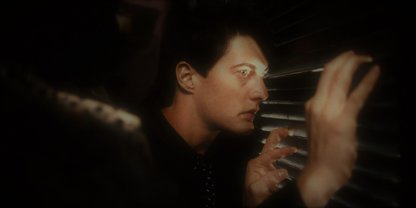
Tom Beaumont (Jack Harvey), the lawn-watering man gravely stricken, is Jeffrey’s father, and his hospitalization forces his son to leave his college studies and come home to run the small family hardware store. Jeffrey is now the man of the house that he shares with his mother (Priscilla Pointer) and chatty Aunt Barbara (Frances Bay). It’s a lot of new responsibility for a youth not that many years past boyhood. And, walking through a vacant lot grass field to see his father after Tom’s seizure, Jeffrey does a boyish thing, stopping to throw a rock at a distant shack and some debris. It’s a warm spring day but Jeffrey wears what a grown-up male (and David Lynch) would wear, a black suit with an unbuttoned beige-gray shirt (which Lynch ​would button): his rock-tossing and attire emphasize his boy-man status. Before he heaves his rock, Jeffrey stands for a second with his back to us as he regards the tawny grassland, assuming a pose that Lynch’s heroes have exhibited in The Grandmother, The Elephant Man, and Dune. The energy the watcher puts into his looking compels us to tip forward in our seats, as though the scene had a hidden message to tell us. This repeated image is the way Lynch the artist sees himself: a figure in black contemplating a murmuring world. Jeffrey’s surroundings will have to speak to him, for his father cannot. At the hospital, Tom Beaumont lies in bed, his head immobilized within a torturous framework of metal rods. Pushing a button device at his throat, he tries to talk, but like many Lynchian characters (and, sometimes, the director himself), he can’t get the words out. Father and son can only touch hands and shudder together on the verge of tears. Like all young children, Lynch had troubling thoughts of his parents getting gravely sick or dying, and Blue Velvet’s stricken-father theme may reflect an experience Lynch had when he was eight. Walking through his idyllic smalltown Idaho neighborhood, Lynch “saw a boy my age sitting in the bushes crying. I didn’t know this boy, but I asked him what was wrong, and he said his father died. It just killed me. I didn’t know what to say, so I just sat with him for a while.”
Lynch continues his doubling ways and has Jeffrey pass by that grass field again. Needing to blow off his sadness, he stops and throws more rocks this time. Jeffrey’s first field scene was accompanied by Angelo Badalamenti’s low-key jazz music, but now Lynch subtly stresses the human hearing function by filling the soundtrack with the chirping and buzzing of birds and insects (the film’s totemic symbols of, respectively, good and evil, innocence and experience). His ears absorbing the sounds of both light and dark forces, Jeffrey makes a discovery that tips his world toward shadowed realms. A human ear lies in the golden grass, as though it is an entryway leading down underground, where dark insect appetites pounce and devour. Lynch now fills our ears with a high insectoid singing as his camera studies this object that he has created with painterly care and detail. The pale ear, roughly severed from a living person, is smudged with a little dirt and some gray-green splotches of decay, a few blackhairs sprout from its top curve, and small brown ants crawl and feed near the central black hearing canal opening. The artist has spoken of the abstract beauty that he sees in objects that consensus reality deems to be repulsive, the way our preconceived associations about an object color our perception of it. “Take an old used Band-Aid in the street. It’s got some dirt around the edges and the rubber part has formed some little black balls, and you see the stain of ​a little blood and some yellow on it, a little ointment. It’s in the gutter next to some dirt and a rock and a little twig. If you were to see a photograph of that not knowing what it was, it would be unbelievably beautiful.”
Lynch himself no doubt finds the ear aesthetically pleasing, just as he loves rusty, old, moldering factories in real life but, as with the negative, threatening way he portrays heavy industry on the screen, he knows that most viewers will be shocked and frightened by the severed skin and he uses it for that effect. Jeffrey is fascinated by his find; he only winces slightly as he picks up the ear with his fingers and slips it into a paper bag. This is a bold meeting of live and dead flesh that eclipses Jeffrey’s more self-protective approach in the script, where he uses a twig to push the ear into his sack. The young man has a need to touch the quick of death as well as life, and his journey has begun.

Lynch the artist knows that our alert senses can transport us into experiences of profound discovery. “If Jeffrey hadn’t found the ear, he would have walked on home, and that would’ve been the end of it. But the ear is like an opening, a little egress into another place, a ticket to another world that he finds.” The director gives many of his heroes such tickets. The Grandmother’s Boy finds the bag of seeds that will grow his loving Granny, Eraserhead’s Henry enters his apartment’s radiator and embraces Heavenly Love. When Dr. Treves meets The Elephant Man’s John Merrick, both of their lives change, and when Merrick rests his head on his pillow, he merges with his lost mother for eternity. For Dune’s Paul Atreides, a spaceship to the desert planet is the first step to becoming Master of the Known Universe. When Sailor and Lula blast off in Wild at Heart’s Thunderbird convertible, they begin a high-octane trip through Hell and Heaven. And Laura Palmer’s plastic-wrapped corpse leads Twin Peaks into deep earthly and cosmic mysteries. Lynch adds that, in Blue Velvet, the ear “draws Jeffrey into something he needs to discover and work through.” The youth needs to become a man, to experience the hot, wet rawness of sex and violence and evil that’s hidden within his chaste little town, to be fully conscious that he has the capacity for both light and darkness within his own soul, and to then resolutely choose the righteous path. 
​
By day, the ear is a naturalistic object that Jeffrey dutifully takes to Detective Williams (George Dickerson) at the Lumberton Police Department, a clue that launches a careful combing of the grass field where Jeffrey found it. There, investigators lay out a gridwork of string lines like the one in the Beaumonts’ garden where Jeffrey’s father collapsed: human design again trying to put a frame around chaos. But by night, as Jeffrey walks dark neighborhood streets with rustling trees arching overhead, Lynch makes the ear a passageway into the youth’s primal psychosexual adventures. With his shirt now buttoned to the top like Lynch’s, Jeffrey’s form dissolves into a shot of the ear, which the camera approaches ever closer, dissolving through the archway of the hearing canal into the curving inner passageway of the organ as the soundtrack roars with a pressurized hissing. Lynch then dissolves this interior penetration into Jeffrey arriving at the arched doorway of Detective Williams’ house, where he’s welcomed in by Mrs. Williams (Hope Lange). The first thing we see inside the house is the arching, golden oval frame in which rests the cherished smiling photograph of the Williamses’ golden daughter, Sandy. These five shots, subliminally joined by the echoing arched forms, are a hypnotic example of the way Lynch wants to “float” us into the experience of his films, to carry us on a flow of imagery that feels like our own dream. 
Like Lynch’s father, Donald, Detective Williams has a homey innersanctum office, and he ushers Jeffrey in. Jeffrey may have gained access ​to Williams’ private domain, but the policeman says he can’t say anything more about the case until it’s “sewed up.” The youth literally twitches with curiosity and, carried away by his romantic view of crime fighting, says it must be “great” to be a defective, but the seasoned cop, who’s actually seen the worst the world has to offer, somberly adds, “And horrible, too.” The message to Jeffrey, courteously delivered: Leave this dirty business to the big boys.
​Jeffrey, mannerly as any well-brought-up kid in a 1950s TV show, says goodnight to the Williamses and asks them to say “hi” to Sandy. 
​Once again, as in the grass field, Lynch puts Jeffrey in the position of “if he hadn’t found the ear, he would have walked on home, and that would’ve been the end of it,”76 but the severed flesh keeps echoing. As the youth leaves the Williamses’ door and heads up the sidewalk, he hears the night speak to him in a disembodied female voice: “Are you the one who found the ear?” The voice is behind Jeffrey, and he turns toward it with the same motion that Henry in Eraserhead turned to find his love, the Lady in the Radiator, in a transcendent flood of light. Jeffrey sees only blackness and the hint of a weeping willow branch stirring upper left. Then, in one of Lynch’s most gorgeous images, a faint, pale form materializes out of the dark, getting larger and taking on color as it approaches and becomes the teen angel, Sandy, golden hair falling down her long neck, bared collarbone framed by a pink dress, an unsmiling wisdom on her slightly parted lips. Lynch frames Sandy’s approach from the waist up so that we don’t see her walking; she truly does float into Jeffrey’s life. The director has spoken of his admiration for the great American painter Edward Hopper (1882–1967), and the way that Lynch and his cinematographer Frederick Elmes make Sandy positively glow against the night reflects Hopper’s technique of frontlighting objects and people that are standing before a looming darkness. Elmes’s color photography for Lynch’s films has occasionally been criticized by prosaic viewers for inconsistency: Some passages are super bright, others almost indiscernibly murky. The reason, of course, is that these shifting tonal moods create the atmosphere that the director is after. As Elmes once put it, “David and I spend a lot of time figuring out how dark is dark.”
Jeffrey answers Sandy’s “Did you find the ear?” with a question of his own: “How did you know?” She continues to float in his mind as an agent of mystery as she replies, “I just know, that’s all,” and steps ahead on the sidewalk. Jeffrey, of course, follows her lead. They both acknowledge that her father said not to talk about the case, but the allure of the unknown makes them circumvent the rules. Lynch builds on the deadpan severed-ear humor that Detective Williams unconsciously expressed (“when the case is sewed up”) ​by having Sandy say about the case, “I don’t know much but bits and pieces; I hear things.” Sandy, like lead characters in The Grandmother, Eraserhead, The Elephant Man, and Twin Peaks, has an upstairs bedroom. For most of these people, the house’s upper regions, which symbolically correspond to the mind’s higher consciousness, are places of deliverance from earthly trials, though Twin Peaks’ Laura Palmer endures abusive terrors up under the eaves. Sandy’s room gives her knowledge; it’s situated above her father’s office, so police-business details filter up through the floor. In Lynch’s world, sometimes two people in a room can’t make out each other’s words, but on occasion the invisible can speak. 
The communication between Sandy and Jeffrey is certainly flowing freely; there’s an immediate bond of sympathy and trust between these two solitary nightwalkers who have found each other. She tells him that she keeps hearing her father mention a woman singer who lives in an apartment near Jeffrey’s house and the field where he found the ear. To this moment, Jeffrey’s equation of mystery had been simple and inert, with no place to go: It was just him and the ear. Suddenly, the beautiful woman at his side has given the equation a thrilling triangulation that vivifies it with open possibility; now it’s Jeffrey, the ear, and this nameless singer. He is moved to sigh with the night wind, “It’s a strange world, isn’t it,” and Sandy, his perfect complement, answers, “Yeah.” As with a couple who’s been together a long time, she anticipates his next thought: “You want to see the building where she lives, don’t you?” 
excerpt from the  book: David Lynch: Beautiful Dark / Greg Olson 
0 Comments


Leave a Reply.

    "A Love of UIQ": Félix Gutattari's Unfilmed Script
    Alejandro Jodorowsky - Dune 'The Movie You Will Never See'
    Barrage (2017)
    Before the Rain (1994)
    Blade Runner - A Camera on Violence: Reality and Fiction
    BLADE RUNNER 2049 AND ARRIVAL: a pedagogical cinema
    Brakes (2017) - Talks with Mercedes Gower
    COLUMBUS’ REVIEW: THE BEAUTY OF THIS MOTION PICTURE IS THE PICTUREn Text
    Darren Aronofsky - Mother! (2017)
    David Lynch - Night Town (Part 1)
    David Lynch - Night Town (Part 2)
    David Lynch - NIGHT TOWN (Part 3)
    David Lynch- NIGHT TOWN (Part 4)
    David Lynch -Head Like A House On Fire (Part 1)
    David Lynch - Head Like A House On Fire ( Part 2)
    David Lynch - Head Like a House on Fire (Part 3)
    David Lynch - Our SchoolGirl Of The Sorrows (Part 1)
    David Lynch - Our Schoolgirl Of The sorrows (Part 2)
    David Lynch - OUR SCHOOLGIRL OF THE SORROWS (Part 3)
    David Lynch - OUR SCHOOLGIRL OF THE SORROWS (Part 4)
    Dziga Vertov - The Man with the Movie Camera (1929)
    'Dune' (1984)
    Gabriel Range - Death of a President
    Germaine Dulac & Antonin Artaud - The Seashell and the Clergyman
    Inland Empire (2006)
    Ingmar Bergman - Hour of the Wolf/Vargtimmen (1968)
    Jean-Luc Godard - Alphaville (1965) (full movie)
    Jean Luc - Godard - Weekend
    Jean - Luc Godard - My Life to Live
    Jean-Luc Godard - Numero Deux ( Part 2)
    Jean -Luc - Godard - Numero Deux (Part 1)
    Jean-Luc Godard - Numero deux (Part 3)
    Jean-Luc Godard - Numero Deux (Part 4)
    Jean-Luc Godard - Breathless
    Mark Fisher - Existenzialism and Inhumanism
    Mark Fisher - eXistenZ and noncognitive labour
    McKenzie Wark - Edge of Tomorrow: Cinema of the Anthropocene
    MOTHERS (2010) by Milcho Manchevski
    DOMINICK SUZANNE-MAYER - No Country for Old Men and the Unavoidable Cycle of Greed and Violence
    No Country For Old Man - Cinephilosophy dialogue with Gabriele Guerra
    On the Milky Road (2016)
    PI (1998)
    Pier Paolo Pasolini - Salò (120 Days of Sodom)
    REWEIRDING ARCADIA
    Saltwater(2014)
    Silence (2016)
    Song To Song (2017)
    TERENCE BLAKE - ANAMNESIS AND ESTRANGEMENT (2): Jodorowsky’s DUNE
    The Death of a President interview with Gabriel Range
    The Dead Man 2 : Return Of The Dead Man (1994)
    The Dinner (2017)
    The Hours (2002)
    THE SPACE IN BETWEEN(2016)
    T2 Trainspotting (2017)
    The Daughter (2015)
    The Handmaiden ( Ah-Ga-SSI), (2016)
    The Other Side of Hope (2017)
    The Salesman (2016)
    The Young Karl Marx (2017)

    Archives

    December 2018
    January 2018
    December 2017
    November 2017
    October 2017
    July 2017
    June 2017
    May 2017
    April 2017
    March 2017
    February 2017

    RSS Feed

Powered by Create your own unique website with customizable templates.
  • OnScenes
  • News
  • Art
    • Music >
      • Album Review
    • Poetry
    • Film >
      • Filmmakers >
        • Movies
    • Theater >
      • TheaterMakers
  • Philosophy
  • PhiloFiction
  • Science&Technology
  • Economy
  • Media
    • Video
    • Audio
  • About
  • Contact
    • Location