OnScenes
  • OnScenes
  • News
  • Art
    • Music >
      • Album Review
    • Poetry
    • Film >
      • Filmmakers >
        • Movies
    • Theater >
      • TheaterMakers
  • Philosophy
  • PhiloFiction
  • Science&Technology
  • Economy
  • Media
    • Video
    • Audio
  • About
  • Contact
    • Location

'No Country for Old Men' - Cinephilosophy dialogue with Gabriele Guerra

6/9/2017

0 Comments

 
by Carlo Antonicelli
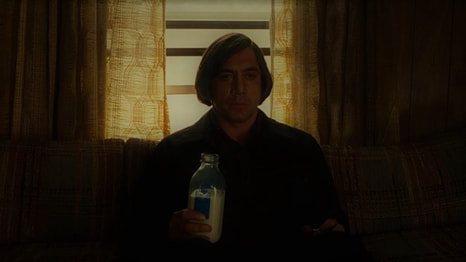
No Country for Old Men, a film of ruthless pessimism that graciously chiseled work by Cohen brothers, has succeeded almost perfectly to overcome the poetic sign and the content of the same book of Cormac McCarthy. A work, that of the Texan author, capable of metabolizing and representing the Zeitgeist of the time in transit, and in particular the dialect of Western civilization.
Picture
Carlo Antonicelli: I would like to start with the figure of the sculptor Bell, an elderly man who wakes up from the incarnation of the wise figure of a wise man, finds himself in front of the wondrous wickedness and violence that he does not seem to understand or want to understand. To me, it is pertinent, but anchestrating, that the one who ought to be the lover of the "healthy" values of the nation refrains from applying them as if it were overwhelmed by a louder necessity than him.
Gabriele Guerra: It does not seem to me that the position of the scribe is described as "agnostic" around the problem of the other: in the contrary, the Sheriff Bell seems to me an "ascetic" figure of radical rejection of evil. Like all ascetic figures - it suffers, like all the "saints": but the definition would lead us to an overly religious context - the sheriff knows good the evil of the world, he obviously fought him, but now has intervened a form of rethinking his own action, Which leads him to change his behavior (bottom Askesis in Greek means first and foremost "practice", and therefore there is no movement of a practical philosophy, that is, ethical), that it ceases to withdraw from any "action", but not necessarily approaching "contemplation" (which is the "Antithesis around which, as is well-known, Christian-Western ascetic practice is built).
C.A.: The same Sheriff -Bell in Western dramaturge is absolutely heterogeneous. It is not courageous, but it would be unclear. It's bipolar, "he says even unfortunate bad guys in the book, and McCarthy does not care to protect him. In the movie, but still, in the book, Bell regrets the times gone by, a mixed attitude of cynicism disenchanted toward this world. But this talk about lost tradition has not originated very early, already in the first Aristotle? How come back to common sense and the plot of this work?
G.G.: True, Bell incarnates everything in Western movies we're used to considering the "hero". But we need to look at the figure. The key to understanding his attitude is instead the "dream" telling his wife how to spin the end of the movie: his father riding overboard him, handing himself a burning torch, traveling on a road to cook a new bonfire to give way to something like a new beginning. The dialectical light/darkness on which the interpretable is built (that is, that asymptotic process that leads us to approach the "truth", which is in the depths of the story of telling), obviously articulates a problem (religious but not only) Specifically modern: the jammed with the tradition. In this regard, I do not know how to deal here with the first Aristotle, as you say; With this dialectic I meant rather a very conceptual - not archetypal - device that maybe, if anything, we find ourselves in Plato (but I prefer to refer to the testament contest, particularly to the Gospel of John). The fact is that the world is irreparably shaded in a partially illuminated and (still) obscure implies not only a dialectical, but also a moral so to speak: on the one hand, there are some who are still dominated by darkness, who do not mind and continue to this to do evil. On the other hand, those who, illuminated by the light of salvation (from the Messiah's truth), are able to see the world in the connexions (and disconnections) - an elective dialect of choice and not. ​But let's go back to the relationship with tradition: while the "natural" transmission chain of salvific knowledge (the lighthouse illuminating the path) involves the passage of father son, the gnostic period in which the action of the film lives, or the perception of a world impregnated with evil, causes it to become overwhelmed; and if the task of tradition had always been to repeat the same gestures, so that to make and maintain an orderly cosmos (Eliade), now it only becomes the one to interpret the message itself that in those gestures was contained. After that, it will only sit to remember the message itself and then perpetuate that message without understanding it, and so on, in a process of inexorable subtraction. In the end, the problem of the atradition is the problem of memory, as Benjamin it has condensed in the famous formula: "Death is the sanction of everything that the narrator can tell."
C.A.: Throughout the long history, Bell lives immersed in the history of his own family, relatives who like him grow older. Leaving his employability is a breakthrough in tradition, as dictated by me, but in the dream it seems that the very idea of advancing progress, the father passing by his son to light a flame of hope. More in the book Bell invokes the coming of Christ as the sole author of the present state of things. So a Palingenese, an ancient but also popular idea of rejection of the status quo, but in the dream the idea of progress towards the future, and of tempting, seems to me to be subverted in a more radical way.
G.G.:"The father who passes in front of his son" - did not think of Bell's ultimate parable of this interpretation, but gave me a progressive reading, whether it was a breakthrough, sick, in crisis - but still progress; But it seems to me that the frequent recall of the Bell of the Romance to the Christ of salvation confirms my interpretation: in the end, the "new time" inaugurated by the Advent of Christ is a time destined to subvert the pagan continuum - in this sense then the father he does not surpass his son, but simply precedes it, is literally a precursor, representing a "typological" conception of history: all those who intend to make a light of disreputability in the world must adapt to the figure of Christ, becoming his type.
C.A.: Does Bell need to present a weak dietary version? He says she is not a contemplative man, and he seems to be above the events, indeed he is always late on what is happening, is always a step backwards with respect to the violent emergencies. But Bell knows good only as a memory of good, he can not put it into practice. ​Is this a post-modern character in this sense? Or is it more like an amethyst tragic background?
G.G.: I will reply to you with a parable, what Gershom Scholem tells us in closing his book The Great Currents of Jewish Meditation: "When Baal-Shem [the founder of the ultimate throne of Jewish mysticism] had to fulfill some difficult task, he went to a place in the woods, he ignored and said prayers, absorbed in meditation, and everything was done according to his purpose. When, a generation later, Magogd of Meseritz found himself in front of the same task, he went to that place in the woods and said: 'We can no longer fire, but we can say prayers' - and everything went according to his wish. Another generation later, Rabbi Moshe Leib of Sassow had to perform the same task. He also went astray, saying, 'We can no longer ignite the fire, and we no longer know the secret meditations that enliven the prayer'. But we know the place in the wood where all this happened, and that's enough. And that was enough. But when again, another generation later, Rabbi Ysra'el of Rischin had to face the same task, sat in a golden seat in his castle, and said,: "We can no longer fire, we can not say prayers, and we no longer know the illusion in the woods, but of all this we can tell the story. And his story alone had the same deeds as the other three. " It also seems to me to be a good allegory of Bell's dream: tradition is subject to strong corrosion, a progressive reality, what remains is just the possibility of dealing with it-more importantly having lost the "strong" interpretative keys; This is, if you like, a weak, typically post-modern ethic (although I think I do not have to indulge in the Eco as an infinite semiotic game, but to think about it in the tragic nature of its "post-" . Every amletic character is a "post-character").
​C.A.: We come to the character Chigurh. It is possible to understand a figure of the character, but by listening to choosing his own jokes, he parallels his action to a sort of inexhaustible dinecession. As he pulls the coin for air to end the fate of the victims. Chigurh says, "I've got a lot of money and we've come up with it." It seems to have eradicated the freedom to decide. And this is totally inhuman. Chigurh is a Knight of Revelation?
G.G.: Certainly, Chigurh is an enigmatic character. But, like the Oedipus Sphinx, it is only if he questions himself as a "character" in its entirety, while it seems to me a "function" that has only one side, or rather is dominated ('possessed') by its being function - that is to do it, like that of the Sphinx is to question Oedipus, or to put it in crisis. It is then to be asked what type of function incarnations. And in this sense it seems to me to be a very high definition of Chigurh as someone "uprooted by the freedom to decide." The question then becomes: Does Chigurh incarnate the Greek tyche, or if he prefers the inscrutable fate (the thread of the Fates), or is it rather a function necessary for the "salvation economy" evoked by Bell, or 'antipathy' of Christ, in a word Satan? It is not here, of course, to decide on the conceptual fundament - pagan or Christian - but to settle it into a philosophy of history. More concretely, Chigurh is the "diabolic" side of a fairy tale that is its "sim-bolic" moment in Bell. I mean, that while Bell intends to "hold together" the different moments of existence, grouping them in their highest ethical moment - as sanctioned by the "jump" in the symbol - Chigurh seems to me to be represented by a divisional instance, "dia-bolica" just, intending to separate the different plans of existence once and for all. As he wrote what I consider a great Italian philosopher, Vincenzo Vitiello, in his latest book: "Without the world it would hurt evil, without the multiple would not be bad. But it's bad more than negativity. Evil is the manifold not related to one, which is self-evident, nothing separate from the possible".(Reflecting Christianity, De Europa, p.244).
C. A.: Socrates said: "If you really needed what you were doing, you would not hurt; You do it because you do not know what you are doing." But even in the Gospel there is a trait that says this unknowingness approaching, which identifies the malecoline of not knowing what we are doing: "Lord, forgive them because they do not know what they are doing." Llewelyn seems to know how to make the right choices for his destiny and to justify his "small" misdeed. The evil perpetrated by Chigurh, however, is irrational, but at the same time accompanied by a rigorous ethics that leads him to kill Llewelyn's wife in the word he had given to the latter. How do you break this tragic paradox?
​G.G.: It seems very important to me this aspect. To resume what I said above: Chigurh's would not call it "a strong", but rather "a rigid ethos ", that is, demonic in the sense I have illustrated; It seemed like allowed, it is the same as Terminator of all the other machines "programmed to kill". There is no paradox in this regard, but only resistance to evil by the people, like Llewelyn's wife, does not accept this logic. ​It is unfortunate that, unlike what is happening in the novel, his brutal assassination by Chigurh is not shown, I do not want to be explained precisely with reference to his "diabolical" ethos: a behavior that even the eye would give me refuses to see.
​G.A.: Throughout this incredible story and in a sense of violence does not seem strange to let the affair come from the good action of Llewelyn that goes to bring the Mexican water to the desert? Is it just a narrative pretext?
C. G.: It does not, however, seem to be a fundamental engine of the philosophical course that we witness in the film's work: the modern world is structured around an acronymatic and methodological heterogeneous of the ends, which transforms finishing into good and vice versa. Llewelyn's good action is, in other words, a direct, conscientious way as "Socrates said", which is lurking under our eyes; the subject of the process is the conquest of power - money, success, etc., but above all: power of life and death.
G.A.: From the dramatic point of view, McCarthy has decomposed Western classic slabs, and the Cohen have borrowed the way to proceed with the book, succeeding in coinciding with the form and content of the film. The two outlaws, Llewelyne and Chigurh, never clash either with them or with the sheriff, the law is not restored, and the villain is not killed. He thinks that this destructiveness is necessary for the contemporary co-location of this work, and what is its news?
C. G.: No Country for Old Men is a great movie, because as Walter Benjamin  wrote "a significant work, fonds the genre or flows; in the perfect works, the two things merge." It seems to me that all McCarthy's work witnesses to the intrinsic difficulty in this sphere, the relationship of a literary work to a certain genre - in this case the western, as you rightly recall; a difficulty that McCarthy resolves to make it explode, using the background pattern (which is the Mezzogiorno di Fuoco , as you rightly sums up) just to show the inadequacy of the present time only to show its inadequacy at the present time (if you want, it's also a great representation of the impossibility of making an epic today.). But I do not know so much about the American novelist that I may be able to produce in a disagreeable judgment on his work. Cohen brothers make a great film  because they can blend the foundation and the final moment of the genre. Regarding the message it addresses to our present: I do not know how to express it - there is certainly a message inside the "specific film",  as was once said, which I must first emphasize: the violence contained in this film is a sign spectacularly opposed to that of Tarantino's films; while in these the violence becomes calligraphy, distracting exercise end in itself (and thus becomes autonomous, producing an aesthetic that does not succeed in defining "fascist" - if for fascistas the aesthetic worship of violence becomes purpose to itself)), then there is continually Bell's gaze that he judges - and condemns - such an explosion of violence. ​Violence without Tarantino's morality is thus replaced by a morality without violence. And this seems to me to be a short message.
Gabriele Guerra was born in 1968, after graduating in Germanica at the University of Rome "La Sapienza" with a thesis on Walter Benjamin, and having pursued a research doctorate at the Freie Universität in Berlin on political syathology in some Jewish-German thinkers of the first half of the twentieth century, became a professor of German literature at the University of Rome "La Sapienza".

He has written the following volumes:
Das Judentumzwischen Anarchie und Theokratie. Eine religionspolitische Diskussion am Beispiel der Begegnung zwischen Walter Benjamin und Gershom Scholem, Bielefeld 2007;
La forza della forma. Ernst Jünger from 1918 to 1945, Civita vecchia-Roma, 2007.
​
He does not deal with cinema professionally, but he's just a curiosity, especially as far as his philosophical implications are concerned.
https://www.academia.edu/930925/_No_Country_for_Old_Men_._Dialogo_cinefilosofico_con_Gabriele_Guerra
Translated  by  Dejan Stojkovski
0 Comments


Leave a Reply.

    "A Love of UIQ": Félix Gutattari's Unfilmed Script
    Alejandro Jodorowsky - Dune 'The Movie You Will Never See'
    Barrage (2017)
    Before the Rain (1994)
    Blade Runner - A Camera on Violence: Reality and Fiction
    BLADE RUNNER 2049 AND ARRIVAL: a pedagogical cinema
    Brakes (2017) - Talks with Mercedes Gower
    COLUMBUS’ REVIEW: THE BEAUTY OF THIS MOTION PICTURE IS THE PICTUREn Text
    Darren Aronofsky - Mother! (2017)
    David Lynch - Night Town (Part 1)
    David Lynch - Night Town (Part 2)
    David Lynch - NIGHT TOWN (Part 3)
    David Lynch- NIGHT TOWN (Part 4)
    David Lynch -Head Like A House On Fire (Part 1)
    David Lynch - Head Like A House On Fire ( Part 2)
    David Lynch - Head Like a House on Fire (Part 3)
    David Lynch - Our SchoolGirl Of The Sorrows (Part 1)
    David Lynch - Our Schoolgirl Of The sorrows (Part 2)
    David Lynch - OUR SCHOOLGIRL OF THE SORROWS (Part 3)
    David Lynch - OUR SCHOOLGIRL OF THE SORROWS (Part 4)
    Dziga Vertov - The Man with the Movie Camera (1929)
    'Dune' (1984)
    Gabriel Range - Death of a President
    Germaine Dulac & Antonin Artaud - The Seashell and the Clergyman
    Inland Empire (2006)
    Ingmar Bergman - Hour of the Wolf/Vargtimmen (1968)
    Jean-Luc Godard - Alphaville (1965) (full movie)
    Jean Luc - Godard - Weekend
    Jean - Luc Godard - My Life to Live
    Jean-Luc Godard - Numero Deux ( Part 2)
    Jean -Luc - Godard - Numero Deux (Part 1)
    Jean-Luc Godard - Numero deux (Part 3)
    Jean-Luc Godard - Numero Deux (Part 4)
    Jean-Luc Godard - Breathless
    Mark Fisher - Existenzialism and Inhumanism
    Mark Fisher - eXistenZ and noncognitive labour
    McKenzie Wark - Edge of Tomorrow: Cinema of the Anthropocene
    MOTHERS (2010) by Milcho Manchevski
    DOMINICK SUZANNE-MAYER - No Country for Old Men and the Unavoidable Cycle of Greed and Violence
    No Country For Old Man - Cinephilosophy dialogue with Gabriele Guerra
    On the Milky Road (2016)
    PI (1998)
    Pier Paolo Pasolini - Salò (120 Days of Sodom)
    REWEIRDING ARCADIA
    Saltwater(2014)
    Silence (2016)
    Song To Song (2017)
    TERENCE BLAKE - ANAMNESIS AND ESTRANGEMENT (2): Jodorowsky’s DUNE
    The Death of a President interview with Gabriel Range
    The Dead Man 2 : Return Of The Dead Man (1994)
    The Dinner (2017)
    The Hours (2002)
    THE SPACE IN BETWEEN(2016)
    T2 Trainspotting (2017)
    The Daughter (2015)
    The Handmaiden ( Ah-Ga-SSI), (2016)
    The Other Side of Hope (2017)
    The Salesman (2016)
    The Young Karl Marx (2017)

    Archives

    December 2018
    January 2018
    December 2017
    November 2017
    October 2017
    July 2017
    June 2017
    May 2017
    April 2017
    March 2017
    February 2017

    RSS Feed

Powered by Create your own unique website with customizable templates.
  • OnScenes
  • News
  • Art
    • Music >
      • Album Review
    • Poetry
    • Film >
      • Filmmakers >
        • Movies
    • Theater >
      • TheaterMakers
  • Philosophy
  • PhiloFiction
  • Science&Technology
  • Economy
  • Media
    • Video
    • Audio
  • About
  • Contact
    • Location