OnScenes
  • OnScenes
  • News
  • Art
    • Music >
      • Album Review
    • Poetry
    • Film >
      • Filmmakers >
        • Movies
    • Theater >
      • TheaterMakers
  • Philosophy
  • PhiloFiction
  • Science&Technology
  • Economy
  • Media
    • Video
    • Audio
  • About
  • Contact
    • Location

Weekend

5/12/2017

0 Comments

 
Only violence helps where violence rules.
- Bertolt Brecht
Picture
At the beginning of Weekend, as described in the published edition of Godard's screenplay, "we find ourselves in the penthouse of a Paris apartment block, looking out through some french windows to a terrace with green trees beyond. Two men, Roland and a Friend, are seated outside, chatting, a table laden with drinks in front of them." This sounds like the first-act setting for some thoroughly traditional play or movie. The location is comfortable, even luxurious, and the people appear to be members of the privileged classes enjoying their privileges, as Hollywood director George Cukor once described some of his characters. Entering this world, our first reaction might be pleasurable envy, as we settle back for two hours of vicarious enjoyment with a movie whose very title signifies leisure, diversion, and respite from workaday cares.
​
We are in for a bumpier ride than the screenplay's bland description lets on, however, and Godard signals this promptly. The movie's first printed words are not the title but a bizarre label: A FILM ADRIFT IN THE COSMOS. The first sounds evoke not the cozy routines of bourgeois living but the cacophony of modern society - the roar of traffic, the hum of conversation, the insistent ringing of a phone - in all its multitudinous complexity. Soon the movie will offer another enigmatic self-description, A FILM FOUND ON A SCRAP HEAP. Only after a burst of dialogue about death ("Wouldn't it be great if both of them died . . .") and chaos ("Did you know that seven people got killed ...") will the title finally appear, in this startling form- printed in the red, white, and blue colors of the French and American flags.  
loading...
END WEEK END
WEEK END WEE
K END WEEK EN
​D WEEK END WE
EK END WEEK E
ND WEEK END W
EEK END WEEK
​The movie's way of presenting its title merits consideration, since it carries a number of meanings relevant to the picture as a whole. For spectators who saw it in 1967, when it was new, an obvious reference point would have been the pop-art style being catapulted to prominence by Andy Warhol and others who shared (like Godard) a refusal to draw boundaries between rarified conceptualism and earthy materialism. Pop prides itself on absorbing the products and processes of commodity culture, defamiliarizing them through rhythmic repetition and self-referential irony, and transforming them into art objects that are mechanical embodiments of and critical commentaries on the relentlessly productive society from which they emerged. 

The title frame of Weekend announces its pop affinities in two major ways. One is the use of red, white, and blue as its (literally) primary colors. These colors have become hopelessly hackneyed - almost invisible, one might say - through their use in national flags; yet they carried a major expressive punch during a decade when politically alert individuals were ratcheting up their skepticism toward governments that wrapped these hues around themselves as they pursued imperialistic policies, jingoistic wars, and other ill-founded projects. Leftists like Godard were increasingly repulsed by manifestations of brute nationalism in France and also in the United States, which had inherited one of France's most tragic colonial follies (the effort to keep Vietnam under Western control) and carried it to extremes that even moderate politicians were beginning to reject in the second half of the 1960s. Godard was drawn to the red-white-and-blue with a sort of morbid fascination, using the colors with aggressive irony in La Chinoise and other works. This was at once an aesthetic gesture (in themselves, the colors are a vivacious trio) and a sarcastic commentary on current events in the sociopolitical sphere. 

The title frame also evokes the assembly-line aesthetic of pop, which rejects the once-sacred notion that art must have "unique" or "special" properties - a sort of "aura," in philosopher Walter Benjamin's term - if it is to be considered genuine or authentic. The mid-1960s saw a great flowering of cultural production that chose not to hide or camouflage its mass-manufactured origin but revealed and even flaunted the mechanized processes that produced it. Godard was very interested in this development, which both excited his aesthetic imagination and suggested a new departure point for his escalating critique of the culture industry - as in his 1968 film One Plus One, also known as Sympathy for the Devil, which chronicles the creation of a Rolling Stones rock recording, with emphasis on the calculated, repetitive labor that goes into it. Godard readily included theatrical cinema in his expanding list of cultural products that were being deprived of their souls by commercialization and commodification; indeed, not long after Weekend he renounced commercial film altogether, pouring his energy into a search for alternative modes of production, distribution, and exhibition. The design of the Weekend title, stamped out repetitiously and mechanically in a sleek parody of industrial chic, joins additional elements in that movie and other recently made Godard films - the pop-music recording session in Masculine/Feminine, the ad-slogan party scene in Pierrot le fou, the landscape of commercial products in 2 or 3 Things I Know about Her, and many more - to provide a vivid foretaste of his ultrapolitical phase, which would begin with Le Gai Savoir the following year.Finally, the title reflects an important aspect of Godard's artistic method: his habit of putting words and pictures into productive competition with each other. With its eye-catching design and runaway multiplicity, the WEEKEND logo captures the spirit of an age that often values quantity over quality. Equally important, it captures Godard's growing fascination with cinema that "disassembles language into images and makes language out of images," as Angela Dalle Vacche describes the process. He knew that all movies turn images into language; one of his first published articles praised Soviet cinema for giving "the idea of a shot... its real function of sign," that is, for integrating visual material into a languagelike structure with a recognizable "grammar." Doing this equation in the opposite direction, the WEEKEND title card turns language into image, since its verbal meaning is considerably less striking than its shape, color, and overall visual impact. In addition to this double operation - language becoming image and vice versa - Godard gives both image and language a distinctly rhythmic function in many portions of Weekend, often using them to provide more of a "musical" pulse than a "literal" set of meanings. His collagelike conjunctions of the verbal, the visual, and the musical demonstrate his wish to throw different systems of communication into eccentrie new configurations that may (he hopes) produce meanings and ideas not available via more traditional routes. 
​
Along with his affection for Brechtian devices and pop-art irony, this ambition explains the frequent out-of-the-blue wordplay that fills the screen in Weekend - reappearances of the title, pointless reminders of the day and hour, vague indications of Godard's underlying agenda for a scene, and so on. Most interesting are the typographical blocks that attack conventional language head-on: "ANALYSIS" and "FAUX TO GRAPH Y," for instance. These point up similarities between Godard and provocateurs in two radical French movements of the 1950s and 1960s: the Situationist International and its predecessor, the Lettrist International, which proclaimed the limitations of logic by seeking to liberate the letters of the alphabet (innocent building blocks) from the words and sentences (ideological tools) that imprison and control them. Godard was not a card-carrying member of these groups, which have roots in the earlier surrealist and dada movements; indeed, his allegedly "pretentious pseudoinnovations" were attacked more than once in the Internationale Situationniste journal published by Guy Debord and company. Nevertheless, his films often share the Lettrist mixture of deadpan whimsy and dead-serious outrage, and his characters have a frequent habit of spray-painting their slogans onto the scrubbed facades of polite society, a practice the Situationists themselves honed into a fine art during the late 1960s.
loading...
Weekend reached the screen in 1967, when the era known as the sixties was approaching its European climax. Social unrest and political protest were on the upswing, and many French dissidents expected full-fledged insurrection against a capitalist-imperialist order they despised.
These hopes were disappointed the following year, when revolt fizzled and the powers-that-be reasserted their dominance; but the electricity of the period was still building as Godard went into production on increasingly radical films like 2 or 3 Things I Know about Her, with its subversive critique of capitalism and its discontents, and La Chinoise, with its wry look at Marxian alternatives to commonsense norms. Weekend is perhaps the most explosive of these movies; yet while Godard clearly wished to carry the cinematic and political implications of his earlier work to new extremes, he was not quite ready to throw off all traces of traditional moviemaking. What places Weekend among his most exciting films is the fact that within it we see the most drastic transition of his career - from liberal skeptic to radical mutineer - gathering speed and energy before our very eyes. 
​
​The growing urgency of this transition appears to be an integral part of Godard's plan for the film, as it builds from its chatty opening in a bourgeois apartment to its ferocious finale in a decimated countryside. The deceptively conventional beginning hints at the craziness to come, since its main reference points in Hollywood cinema are derived from the film-noir cycle of the 1940s and 1950s, which specialized in tales of intrigue, treachery, and betrayal. Many self-respecting noirs might have inspired the dialogue between our heroine, Corinne, and a friend who's visiting her and Roland, her husband:
FRIEND: Wouldn't it be great when Roland drives your father home if both of them died in an accident?... Did he get his brakes fixed?
CORINNE: No. I managed to make him forget.
FRIEND: Did you know seven people got killed last Sunday at the Evreux junction?
CORINNE: Yeah, that would be great. . . .
And here is Roland on the telephone, a few moments later: "Listen, you're not to phone me here any more. It's dangerous. ... I've got to be cautious after those sleeping pills and the gas.... She may be dumb, but she'll start getting suspicious. . . . Anyway, the main thing is for her old man to croak. Afterwards, when Corinne's got the money, we'll deal with her.... Of course I love you...."

Has this movie stumbled into some outlandish den of iniquity where civilized values have inexplicably been forgotten? Quite the opposite: Civilized values aren't what they used to be, and for Godard, the violenceprone household of Corinne and Roland catches the spirit of the late 1960s as well as Ozzie and Harriet Nelson's home represented aspects of the previous decade. In an age when greed and belligerence have overtaken the Western world at large, people like Corinne and Roland hardly stand out from the crowd. Rather than simply preaching this proposition, Godard weaves his disturbing vision into the substance of the film itself. This clarifies further why he punctuates the action with those jarring, disruptive blocks of typography. In other ways, too, he surrounds the story with signs of social disjunction and dysfunction. The first such outbreak comes between Corinne's conversation and Roland's phone call, when two motorists have a furious fight after their cars collide on the pavement below. This introduces automobiles as the film's main symbolic objects, embodying the materialism and aggression of a society being crushed by its own fetishized commodities. Important too is the look and feel of the brawl as Godard presents it. As filmed from the apartment's balcony, it would appear pointless and absurd even if it weren't so wildly hyperactive (the Three Stooges were never more frenetic) and so wildly out of proportion to the trivial fender-bender that prompted it. The movie is still in its opening moments, but already we see that the sociocultural center cannot hold, human relations are falling apart, and mere anarchy is being loosed upon a world that indeed seems adrift in the cosmos. 

Weekend might be too volcanic to watch if it kept up this pace indefinitely. It shows signs of subsiding as Roland's phone call concludes with a (visual) fade to black and a (verbal) riff that repeats his last words with the inanity of a broken record, recalling Nana's repetitive "parrot talk" in My Life to Live. The following scene has a very different rhythm, with ramblingly long takes and a numbingly long speech by Corinne to her stillnameless friend. 

The film has not settled down as much as first appears, however, and "numbing" doesn't quite describe Corinne's monologue. Prompted by her friend's curiosity, she sits on a tabletop in her underwear and interminably describes a small-scale orgy she had with two companions, Paul and Monique, at their home. The beginning of her speech might have been lifted from an ordinary melodrama: "He started in the Mercedes. . . . We necked for a long time in the parking lot...." Then the scene being described changes to Paul's place and Monique enters the tale, adding a new layer of perversity: "She asked me if I didn't think her ass was too big ... and she turned round, spreading her legs open. . .. She asked me to describe them...." Her voice stays as flat as the table she's sitting on, making wild statements and banal ones in the same affectless tone. 
​
​Is this some new kind of sociopolitical critique or just a dose of oldfashioned pornography? Godard's later film Numero deux asks this question explicitly about its own content, and the answer turns out to be both. The same goes for Weekend, where the ironic absurdity of Corinne's monologue grows increasingly clear, culminating in a round of carnivalistic sex (e.g., Corinne masturbating while Monique squats in a dish of cat milk) that eventually peters out in what can only be called an anticlimactic climax:
FRIEND: Did all this really happen or was it a nightmare?
CORINNE: I don't remember.
​FRIEND: I adore you, Corinne; come and excite me.
Fade to black. Whether all this "happened" or not is moot, of course, since Corinne's words pack a sensationalistic punch regardless of any "real" past events. What matters about the scene is that it escalates Godard's war against the tyranny of images. Convinced more than ever that show business is bad for us, he now wants to undermine the very idea of cinematic spectacle. He does this through a sort of verbal flank attack, combining contradictory elements - prurient speech and puritanical picture - that throw movie-sex conventions into a deliberate muddle. (Adding to the irony is the fact that Corinne is played by Mireille Dare, widely known for sexy roles in commercial films. Roland is played by Jean Yanne, a more conventional choice. Many other characters have no fictional names within the film, incidentally, and are called by the names of the performers who portray them - e.g., the revolutionary leader is called Kalfon after the actor Jean-Pierre Kalfon.) 

The tactics of this scene are based on Godard's conviction that a basic strategy of commercial film (in keeping with the commodity system as a whole) is to stimulate our visual appetites, then gratify this artificial desire by providing the material it has teasingly promised. This is built into the most common pattern of movie editing, where "eyeline match" shots alternate between someone looking and what the person sees. The same strategy is behind almost every kind of narrative scene, from sophisticated suspense sequences (What will the outcome be?) to exploitative sex episodes (What will we see next?). The sound track is usually limited to a supporting role, designed to make the visual tease more alluring and the eventual payoff more gratifying. 

Determined to thwart such manipulative uses of film, Godard has pioneered a provocative (and highly Brechtian) approach that turns image and sound into equal partners, each with its own aesthetic and expressive integrity. Democratized like this, sight and sound have new freedom to interact in unexpected ways, challenging our analytical powers instead of lulling us into passive spectatorship. This is why Corinne's monologue cannot be called gratuitous, to borrow a favorite term of would-be censors. While its subject cries out for pictures, Godard's refusal to supply them makes us keenly aware of (a) how effective movies are at sparking superficial desires, and (b) how much more interesting it can be when a filmmaker calls sardonic attention to these instead of pandering to them on the screen. If show business is bad, how about a cinema that doesn't show? 

Weekend returns to its film-noir roots as Corinne and Roland begin the journey that dominates the movie's fractured story. Jumping into their Facel convertible, they start for the distant town of Oinville, where they hope to pin down Corinne's inheritance and speed the demise of her father so they can collect it - each dreaming of the other's death, meanwhile, so the loot won't have to be shared. 

​They don't get out of the parking lot, however, before encountering more of the slapstick-style buffoonery that punctuated the opening scene. Roland bumps his car into a parked sedan, leading to a quarrel with the owner's little boy, who pockets a bribe and calls his mother anyway. She arrives in a rage; Roland and Corinne fend her off with a paint gun; she retaliates with a blitz of tennis balls; and her husband joins in with a shotgun as their son shouts, "Bastard! Shitface! Communist!" Godard labels the episode with a blue intertitle reading "SCENE FROM PARIS LIFE," as if this were a nineteenth-century literary vignette. His view of urban living is plain: Honore de Balzac meets Moe, Larry, and Curly. 
​

On the road at last, Corinne and Roland promptly run into one of the most bravura sequences in any Godard film: a cinematically stunning traffic-jam scene that brings together many of his most original and subversive ideas. Automobiles are central to this scene, and it is interesting to note how the metaphorical meaning of cars has shifted in Godard's value system. In the early Breathless they represented a Beat-style dream of liberation via speed, flexibility, elusiveness. They played a more somber role in My Life to Live, introducing Nana to the sad pavements she would walk, and carrying her to the lonely street where pimps would gun her down before speeding away to safety. Weekend veers even more sharply in this cynical direction, paralyzing cars altogether by cramming them into a self-suffocating gridlock so devoid of action and energy that the movie itself almost stops moving. 
The scene begins as Corinne and Roland steer their Facel down a country road that's backed up with cars as far as the eye can see. Godard's camera runs parallel to the road, gliding along the shoulder at about the same pace as the convertible. Since everything takes place on the roadway, the action seems stretched and flattened into a two-dimensional spectacle, as shallow as the society that has allowed everyday life to degenerate so badly.
​
Sound also plays a key part in the scene, filling the air with horn honks so loud and persistent that they lose any potential meaning as greetings or warnings. This is cacophony as sheer self-assertion, blaring away with no regard for purpose or utility; yet it conveys a bitter sort of beauty all the same, celebrating its own belligerence with a heedless panache recognized by critic Pauline Kael when she described the horns as triumphant, "like trumpets in Purcell." In addition to its metaphoric value, the noisiness also serves a clever cinematic function - counterpointing the flatness of the image with a direct assault on the audience's eardrums, stamping the scene's immediacy on our bodies as we experience it.

This goes on for hours of narrative time, as Roland maneuvers his Facel through the tie-up with even more edginess and impatience than most of his fellow drivers show. The panorama that he passes, and that Godard captures on film, amounts to a microcosm of social activity: On view are recreation (card playing, a chess match), sports (ball tossing, sailboat rigging), culture (book reading, radio listening), personal hygiene (relaxing, urinating), and so forth. The most arresting images are two that stand out for their own pictorial value as well as the fact that Coutard's camera gives them a bit of extra attention. One shows a traveling menagerie including monkeys, lions, and a llama staring back at us with the calm assurance of a creature that knows its dignity and integrity are leagues above those of the Homo sapiens so chaotically surrounding it. The other is a gigantic Shell Oil tank truck. It greedily sucks up screen space with its intimidating bulk and aggressive red-and-yellow colors; yet it's even more stymied than the other vehicles, stuck in a nose-to-nose stalemate with a white Fiat headed in the opposite direction on the same stretch of roadway. This is a prototypical Godardian symbol, transforming the personal car crash that climaxed Contempt into a socioeconomic car clash (Shell vs. citizen) with darkly comic undertones. 

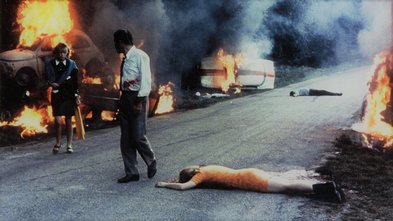
Many arguments, insults, and altercations later, Roland and Corinne finally approach the end of the congestion and discover its cause: a horrifying accident that has left wrecked vehicles and mangled bodies strewn along the street. Not surprisingly, our heroes couldn't care less. They zip past the catastrophe, turn off the main highway, and enter a rural area that holds forth the possibility of a calmer, cooler atmosphere. Roland wrecks the calm about two seconds later, bowling over a trash can as the Facel screeches into a town square and careens up to the curb. We know by now that such reckless behavior is normal in the Weekend world, but more tumultuous upheaval is about to transpire. No sooner has the Facel lurched to a stop than we hear an off-screen crash between a farmer's tractor and a Triumph sports car holding a young woman, who survives the accident, and her wealthy boyfriend, who does not.
​
Roland and Corinne ignore this ruckus, discussing instead what will happen to their plan if Corinne's father uses his "little Japanese tape recorder" to dictate an updated will. "Why have we been sweating it out for the past five years, putting poison in his mashed potato every Saturday?" whines Corinne, dismayed that her work might come to nothing. "Did you see the Triumph?" she adds, finally acknowledging the collision that just occurred. "If only that could have been Mommy and Daddy, it would have made everything a whole lot easier." 
Like many film-noir couples, Corinne and Roland have a strained relationship; but at least they share a middle-class background, which saves them from the class warfare that explodes between the tractor-driving farmer and Juliet, the surviving sports-car passenger. The personal rage displayed by these two is so great that their shouting match seems at first like mere emotionalism. There is no mistaking the gender-based inflections and class-coded subtexts of the insults they hurl at each other, however, and Godard underscores this political dimension with on-screen labels ​- all in bold blue letters. Juliet fiercely belittles the farmer: "It makes you sick that we've got money and you haven't.... You're pissed off because we fuck on the Riviera and you don't.... I bet you don't even own [your tractor] and it belongs to one of those rotten unions or some fucking cooperative. ..." The farmer shows more political intelligence, but bogs down in ideological argument: "If it weren't for me and my tractor, the French would have nothing to eat." Juliet trumps him with "You big lump of shit!" and other colorful yelps.
ss
SS STRUGGLE
THE CLASS STRUGGLE
With its unhappy premise and outrageous dialogue, this episode is an uneasy blend of tragedy and farce, leaving us uncertain how to respond. Piling on more ambiguity, Godard inserts an incongruous shot of Juliet posing with an advertising billboard (flanked by a brassiere ad and an Esso tiger) wearing a pensive expression on her face. Later, when the farmer launches into a reasonable-sounding criticism of Roland's awful driving, a similar cutaway shows three men we've never seen before, perhaps bystanders listening to the argument, or perhaps Brechtian intruders who are not part of this story at all. Subsequent shots show a smiling man, his girlfriend, and another fellow in a baseball cap. The published Weekend screenplay assumes these figuresa re watching the fight between Juliet and the farmer, but their stiff, apathetic poses suggest complete separation from the narrative. In any case, these shots serve the same purpose as the movie's full-screen titles, disrupting what might otherwise be an absorbing - and therefore morally unacceptable - melodramatic scene.

​Godard finishes off any lingering traces of normal melodrama with a sardonic plot twist. Arguing so fiercely that they come to blows, Juliet and the farmer appeal to Corinne and Roland as witnesses of the fatal crash. Roland scoots his convertible past them with scarcely a nod, naturally infuriating them - and radicalizing them, to the point where they instantly unite against the outrageous couple. "You can't leave just like that! Aren't we all brothers like Marx said? Bastards! Bastards!" hollers the farmer. Juliet's parting shot at the motorists is far more scandalous - "Jews! Filthy rotten stinking Jews!" - but the farmer sympathizes without hesitation, wrapping an arm around his erstwhile enemy and escorting her from the scene. By satirizing anti-Semites and Communists in almost the same breath, Godard proves he is far from the party-line Marxist for which some critics still mistook him in 1967. Indeed, this scene shows his skepticism toward all parties in the "ss CLASS STRUGGLE," including the oftenidealized working class. ​
​
​The screen then fills with FAUX TOGRAPHY in blue letters, and all the dislocated strangers from the preceding episode pose neatly before the bill
​board. Roland is there too, comforting himself over Corinne's momentary absence by embracing Juliet, still covered with blood from her recent accident. What's going on here? The answer is murky, and again that is precisely Godard's point. All we know for certain is that strange days are increasingly upon us.
​Together again, Roland and Corinne are confused as well. Red and blue numbers tick off kilometers as their Facel zooms along a country road, bringing them closer to their destination but hardly reducing their hostility toward each other.

"When did civilization begin?" asks Corinne, taking a break from their bickering. Her question seems slightly odd, since their surroundings are rural, not conspicuously "civilized" in the way an urban setting would be. What she is discovering - along with us in the audience - is that Weekend findst he countryside more conducive to true civilization than the city or suburbs. This is not because "nature" carries some essential grace, a la Rousseau, but because its comparative distance from the power/knowledge networks of mainstream society makes it a productive place for romantic outlooks, Utopian daydreams, and revolutionary experiments. This outlook defines "civilization" in an ornery way, suggesting that the bursts of rural anarchy in this increasingly anarchic story are more civil and refined than the suburban milieu Roland and Corinne have left behind. Weekend is an ornery movie, however, and Godard - whose passionate love of the natural world will radiate through the postpolitical landscapes of later films - sees the countryside as an appropriate place to unleash the purgative powers of his growing sociocultural rage. The characters we meet in this rural "civilization" are like the "uncivilized" protagonists in Band of Outsiders two years earlier. "They have neither the mentality of thieves [nor] of capitalists," Godard metaphorically described the Outsiders figures." They're like animals. They get up in the morning. They have to find a bird to kill so they can eat at noon, and another for the evening. Between that, they go to the river to drink. And that's it. They live by their instincts, for the instant. The danger would be to make a system of it." Later in Weekend we will spend harrowing time with people who have made a system of it, and "dangerous" is a mild word for the results. 
​
For now, Corinne is still trying to fathom the previous scene. "I don't understand," she gripes, referring to the farmer's comment about Marx calling all people brothers. "It wasn't Marx," replies Roland, "it was Jesus - another commie." For once, Godard has put a coherent thought into Roland's muddled mind, recalling that Marx and Jesus shared certain 
notions about genuinely "civilized" life. Corinne has already lost interest, though. "Even if it's true," she asks, "who cares? We're not living in the Middle Ages." Her fleeting philosophical moment gives way to a series of highway encounters, as jarring and fractured as the traffic-jam scene was prolonged and hypnotic. Quick-cutting vignettes show furious battles with other motorists, complete with biting, hitting, hair pulling, and outrageous insults. Civilization may exist alongside the roadway, but on the asphalt a Three Stooges mentality remains alive and well. Corinne's casual question about entering civilization gathers more ambiguity as Weekend proceeds, since evidence suggests that everybody involved (i.e., the characters in the film and the audience watching it) is leaving an old, familiar world and sliding into a new, disorienting mode of existence. While this new realm is superficially the same as the one it replaces, rational structures and reasonable controls seem mysteriously missing. Godard finds this both exhilarating and terrifying, and encourages us to experience it with the same ambivalent wonder. Lest we underestimate how drastically the movie's world has changed, the next scene makes this so evident that even the most resistant spectator must recognize its radicalism and confront its implications. The convertible roars down a country road in a teeming rainstorm. A woman, decked out in a red raincoat and white boots, waves for it to stop alongside an accident site with two smashed-up cars. She asks for a ride, and Roland responds by checking out her body, even lifting her raincoat to inspect her derriere. (This echoes Michel's evaluation system for hitchhikers in Breathless; the woman puts up with it as normal masculine behavior.) Deciding she meets his specifications, Roland motions her toward the Facel's back door. However, like many a hitchhiker, she has a companion waiting nearby, and he now crawls from one of the wrecks, wearing a coat that matches hers and carrying a slender tree branch in one hand. He demands a ride in the opposite direction; when Roland demurs he fires a gun, brandishes his leafy stick, and prods Roland through a U-turn, just as a lion tamer would put a circus animal through its paces. Filled to capacity with its four passengers, the Facel heads back in the direction whence it came, and the scene gives way to a full-screen intertitle that changes as we watch:
THE
                                                                           ANGEL 
     THE EX
                                                                          ANGEL
THE EXTERMIN
ATING ANGEL
This is a typical Godardian joke, making a film-buffr eference to Luis Bufiuel's masterpiece The Exterminating Angel (1962), about a dinner party that spirals into chaos when the guests discover they are incapable of leaving. By invoking its title in his own movie, which takes a similar dark pleasure in confrontations between the ordinary and the inexplicable, Godard cleverly cannibalizes its blend of existentialist angst and surrealist drollery. He also injects another Brechtian break into the story's continuity (already shaky), and foreshadows a supernatural/religious element in the episode about to unfold. Claiming to be the product of "buggery" between God and Alexandre Dumas, the hitchhiker-hijacker may be the angel of Godard's film, but he ​certainly doesn't seem like one. Jammed in the back seat, he uses his pistol to keep Roland and Corinne under control - not that other motorists pay any attention to their yowls for help - and snaps pictures of them with a camera. Corinne asks about the photos, and he answers that they are "for the Ministry of the Interior," explaining that "even God has His police." Roland parries that he and Corinne have nothing to fear, since they are married, which legalizes their sex acts. The ensuing dialogue reveals a feminist awareness that is surprisingly strong for a film produced in 1967, when the modern feminist movement was just beginning to pick up speed:
HITCHHIKER: Tell me your name, lady.
CORINNE: My name is Corinne Durand.
HITCHHIKER: No it's not. That's your husband's name. What's yours?
CORINNE: My maiden name is Corinne Vitron.
HITCHHIKER: No, that's your father's name. What's yours?
CORINNE: What? My name? Well, I ...
​HITCHHIKER: That just shows you. You don't even know who you are.
This critique of patriarchal power, which traverses the kinship system to gain control of identity itself, is followed by a reference to language and religion. "Christianity is the refusal to know oneself," the hitchhiker says. "It's the death of language." 

Language and religion are such significant topics for Godard that we should pause to see how their relationship has been evolving in his films. He set forth his deep respect for language in My Life to Live, seeing it as a precondition of thought itself. Another slant on this appears in Masculine/Feminine, made a year before Weekend, when the main characters watch a pornographic film showing a woman being abused by a man who communicates in grunts and barks. The brutality of this scene, one critic suggests, derives "as much from the absence of language as ... from the man's rape of the woman." Also significant is an observation by one of the Masculine/Feminine characters that the porno movie is presented in its "original language." Combining these elements - "absence of language" and "original language" - with the idea that "language is the house man lives in," as 2 or 3 Things I Know about Her stated, it follows that the "original language" must be "no language, man before language, a beast."10 At this stage in his career, Godard apparently sees language as a progressive medium for "purifying sexuality from brutality and violence," in critic Yosefa Loshitzky's words. This means that a force like ​Christianity, bringing "death of language" and "refusal to know oneself," is limiting and destructive.
​
Godard will change his mind in eighties and nineties films like Hail Mary and Nouvelle Vague, seeing the "original language ... no language, man before language" not as bestial, but as blessed and inspired; yet Weekend, in its own obstreperous way, already points in this direction. Although the obnoxious hitchhiker does not make a very appealing prophet, he has a definite mission to perform: "I am here to proclaim to these modern times the end of the grammatical era and the beginning of an age of flamboyance in every field," he announces, "especially the movies." Since this is an accurate summary of Weekend itself, we are evidently watching not just a movie but an annunciation - a scruffy, belligerent, chaotic annunciation, but flamboyant enough to suggest that the grammatical era may indeed be having its apocalypse even as we watch.
Godard is no less determined than the hitchhiker to jettison commonsense stylistics. Accordingly, he continues the intruder's scene with an increasingly eclectic melange of images and sounds. Trying to impress Roland and Corinne with his semidivine nature, the hitchhiker offers them "whatever you want" in return for a ride to London; to prove his worthiness as a credit risk, he performs a hilariously trite magic trick, conjuring up a white rabbit under the dashboard. Corinne responds with equally hilarious ambivalence, squealing "Shit! A miracle!" as she hauls the animal into the open. Realizing they've stumbled on a gold mine, she and Roland deluge the hitchhiker with their wish list, and it's just the sort of mindlessly materialistic catalog this pair would be expected to dream up: a large Mercedes, a Saint-Laurent evening dress, a Miami Beach hotel, a headful of blond hair, a fleet of Mirage IV aircraft "like the yids used to wipe out the wogs," and a weekend with James Bond - a prospect that turns both Corinne and Roland on. Less of a lowlife than he appears, the hitchhiker refuses to gratify the couple, although his reason is unclear. "Is that really all you want?" he asks, not specifying whether he is disappointed by their materialism or by the banality of their demands.
​
So far, Weekend has been a bitter parody not only of film noir but also of Hollywood's cultishly popular road-movie genre. Now it becomes more of an action picture, as Corinne snatches a pistol from the hitchhiker's companion and helps Roland chase them across a grassy field. The genre and tone of the picture then become indeterminate for a moment, as the hitchhiker runs toward a wrecked car, raises his hands, and demands silence, like a patriarch in some old Cecil B. DeMille epic. He appears to be working up another miracle, and Godard accomplishes it for him, cutting to a shot nearly identical to the first, except that the characters are surrounded by a huge flock of sheep that has materialized out of nowhere - or rather, out of Bunuel's film The Exterminating Angel, which ends with a similarly mysterious image of sheep swarming through a public place for no earthly reason. Grabbing the gun in this confusion, the hitchhiker chases Roland and Corinne back to their Facel, yelling "Vade retro! Go home!" Are we under the Exterminating Angel's spell? If so, who embodies this apparition? It could be the hitchhiker, who has performed two miracles; it could be Godard, who actually accomplished these, using tacky miseen-scene tricks (the rabbit) and extravagant montage feats (the sheep) that recall Hollywood's version of biblical supernaturalism; or it could be the Spirit of Intertextualism, presiding over Godard's clamorous call for a cinema as cluttered, tumultuous, and flamboyant as his own moral imagination.
Speeding along in their Facel again, Roland and Corinne pilot the car like infantry soldiers battering their way through hostile territory. Honking and hollering, they force a bicyclist, another small auto, and a pedestrian off the road, meanwhile swerving into a couple of near-collisions and running over a hapless chicken. Scrambling the movie's time sense as much as its geographical bearings, Godard propels us prematurely into the next scene with lightning-quick flash-forwards, showing a horrific accident engulfed in flames and smoke. We then plunge into this purgatory as Roland drags himself from under the pileup, while Corinne screeches her agony in one of the movie's most savagely satirical moments. "Help! My Hermes bag!" she shrieks in infinitely mournful tones, oblivious to the horror and suffering (including Roland's bloodstained condition) all around her.
​
​Narrative time, space, and consistency - the chronotope of the movie - continue to bend and wobble as Roland and Corinne trudge along a path after their catastrophic crash. Striding with them is none other than Louis Antoine Leon de Saint-Just, a major figure of the French Revolution, dressed in eighteenth-century clothing and reading from a book in stentorian tones:
Freedom, like crime, is born of violence ... as though it were the virtue that springs from vice ... fighting in desperation against slavery.... The struggle will be long and freedom will kill freedom. ... Can one believe that man created society ... in order to be happy and reasonable therein? No! One is led to assume that, weary of the restfulness and wisdom of Nature, he wishes to be unhappy and mad. I see only constitutions that are backed by gold, pride, and blood, and nowhere do I see ... the fairness and moderation that ought to form the basis of the social treaty.
These words clearly relate to Godard's radicalized social philosophy, lamenting the human strife bred by capitalist vices of greed and competition, which have corrupted the natural world. They also relate to Godard's filmmaking strategy, whereby the virtue of freedom - that is, a liberated cinema - must be born from a violent, take-no-prisoners assault on "slavery" to classical style and conventional narrative. Since the kind of filmmaking represented by Weekend is all but unprecedented, Godard's audience must decide whether he and his troops are winning this battle on our behalf, or whether "freedom is killing freedom" in a political-aesthetic skirmish that may prove Pyrrhic at the final fade-out.

Slicing the film's continuity into more collagelike fragments, intertitles reading "SU ND AY" and "STORY FOR MONDAY" appear in confusing alternation. Saint-Just leaves the screen, then returns long enough to repeat his last words. A new pan shot of Roland and Corinne makes two false starts before proceeding beyond its first few frames; and though Saint-Just has indeed gone, the actor who portrayed him (Jean-Pierre Leaud) is still around, now playing a young man who opens the sequence with an offscreen cry: "I'm calling out in the emptiness." These words may sound like another outburst of angst and absurdism, but the fellow is merely singing a message to friends from a conveniently placed phone booth. (An intertitle has labeled this portion of the movie FROM THE FRENCH REVOLUTION TO WEEKENDS WITH DE GAULLE, and the two characters played by Leaud embody this chronotopic leap.) Roland and Corinne soon arrive and, as we might expect, patience at public telephones is not among their virtues. Roland pesters the man to finish. The singing man persists, altering his lyrics ("I'm afraid I've got to hang up now/There's some people outside, they can't wait") to suit the circumstances. Roland prods him by climbing into his Honda and starting its motor. The young man buzzes out of the phone booth, and another slapstick struggle ensues, which he wins, using a jack handle and tire as a sword and shield. Roland and Corinne limp into the next scene among burning and exploding cars, asking directions from corpses scattered along the roadside. "These buggers are all dead," says Roland, with his usual degree of compassion.
 
The next sequence requires only one false start before it actually begins: a glimpse of countryside that immediately fades, then reappears as Roland and Corinne arrive. We are DU COTE DE CHEZ LEWIS CARROLL, as a blue intertitle soon informs us, and the scene's mood of wry parody echoes the tone of Carroll's fiction - although its whimsical blend of literary references (Blake, Brecht, Bronte) goes far beyond the dramatis personae of Wonderland.
​
Roland and Corinne meet two characters on this stretch of road: Emily Bronte, perusing a book as she strolls, and Tom Thumb - or Gros Poucet, his French equivalent - reading from pieces of paper pinned to his clothing, as though he were a child who might otherwise lose them. In the background is a gate that serves no real purpose, since there is no fence alongside it; the words "No Entry" are inscribed across the top. Perhaps this was suggested by William Blake's poem "The Garden of Love," which describes a garden once filled with flowers but now a domain of graves, tombstones, black-gowned priests "binding with briars my joys and desires," and a newly built chapel with "Thou shalt not" written over its door.
The first words Tom recites are taken from Brecht, telling of a time when the German-born playwright was robbed - in Los Angeles, the moviemaking capital "where dreams are for sale" - but kept quiet about the incident since a fellow immigrant was responsible. This anecdote suggests a tellingly ambivalent attitude toward stateless or nomadic individuals, on one hand, and the malaise of materialistic social systems, on the other. Tom has a pebble collection, and Emily helps him build it up with bits of stone found alongside their path. Meanwhile she converses with Roland and Corinne, answering their inquiries about the road to Oinville with a philosophical counterquestion ("Are you looking for poetic or concrete information?") and the dubiously relevant observation that "physics does not yet exist, only individual physical sciences. Perhaps they're not yet physical, even." The scene rambles on like this for a long time, establishing at great length how unable these characters are to communicate on even the simplest level. The travelers keep asking for directions, but the literary figures refuse to budge from their more abstract interests: Emily reels off nonsensical syllogisms, which one critic connects with the Logician's irrelevant exercises in Eugene Ionesco's absurdist play Rhinoceros; meanwhile Tom portentously denounces "the real thieves, the big ones," whose sociopolitical crimes bring "night" and make "the world ... full of horror." One could almost sympathize with Roland and Corinne, whose questions seem reasonable enough to deserve reasonable answers. Godard appears to be satirizing hyperintellectuality that loses touch with human needs.
​
​Once again, though, Corinne and Roland eventually cross the line between understandable frustration and sheer viciousness. A little earlier in the scene, Roland had directed anger not only at Emily and Tom but at Weekend itself, complaining that the movie is "crap ... full of crazy people." Corinne now assaults Emily with the argument that "this isn't a novel, it's life. A film is life!" The travelers then physically attack the English author and her friend. Emily moves to escape, panting, "We must cover the flowers with flames,w e must stroke their hair, we must teach them to read." Savagely parroting her - "So you want to cover the flowers with flames!" - Roland sets her dress on firew hile Corinne holds her from running away. Emily shrieks off-screen as the killers gaze in her direction, and their words reiterate Godard's insistence on blurring all distinctions between the realities of fiction and the fictions of reality:
CORINNE: We are beasts. We have no right to burn anyone, even a philosopher.
ROLAND: Can't you see they're only imaginary characters?
CORINNE: Then why is she crying?
ROLAND: I don't know. Let's go.
​CORINNE: We're not much more than that ourselves.
Corinne's attitude seems close to compassionate for a moment, but the reality of the feral violence she and Roland have committed is underscored by a close-up of Emily's blazing remains. It is not far-fetched to associate this fiery death with the slash-and-burn destructiveness of the war in Vietnam - always on Godard's mind during this phase of his career - and with the self-immolation used by some courageous protestors to denounce that war. (One such was a short-lived character in Masculine/Feminine.)
​Tom ends the scene with a long recitation summing up Brecht's pessimism about a society that relegates artistic and intellectual activity to the status of culture-industry commodities:
I said to myself, what's the use of talking to them?. .. All they're looking for is cheap knowledge they can sell for a high price.. . . They don't want to be oppressed, they want to oppress. They don't want progress, they want to be first. They will submit to anyone as long as he promises that they can make the laws. What can one say to them, I wondered? Then I decided, this is what I will say to them:
​And the scene fades into darkness, suggesting the inability of literary words or cinematic images to ameliorate such evils. If the goal of the oppressed is not to eliminate oppression but merely to take control of its operations, what solution can there be but an end to laws, controls, and social systems of all sorts? Yet such anarchy could carry an exorbitant price of its own, as Weekend will show as its grim progress continues.
​Since the movie's chaos and mayhem have now approached combat-field intensity, it is hardly surprising to read the next intertitle, in red and blue letters: ONE TUESDAY IN THE IOO YEARS WAR. Next comes a close-up of a common worm on a patch of muddy earth. On the sound track, Roland and Corinne chant an assessment of the human race that seems particularly accurate with regard to themselves:
ROLAND: We don't know anything.
CORINNE: Yes, we are entirely ignorant of our own natures.
ROLAND: As ignorant about ourselves as about this worm.
CORINNE: Both of us are enigmas.
​ROLAND: And whoever denies this is the most ignorant of the ignorant.
To the extent that this is a self-analysis by our troublesome protagonists, few moviegoers are likely to argue with it. 
Roland and Corinne are resting in another rural field, rousing themselves only when they spot some spiffy clothing on a corpse in another of the horrific auto wrecks that still litter the story. Corinne says her mother has surely changed the all-important will by now, but Roland has not given up. "We'll just have to torture her to make her change her mind," he says. "I remember when I was a lieutenant in Algeria, they taught us a trick or two." They pause so Corinne can hail a big yellow truck by lying in the street with her trousers off and her legs open, giving "on the road" a smarmy new meaning. 

Godard's interest in Brechtian digressions has not diminished, and now the title MUSICAL ACTION introduces a scene with more of the former than the latter. After agreeing to help the truck driver in return for a ride, Roland and Corinne wind up at a farmyard piano recital, where their new acquaintance plays a Mozart sonata with rough-hewn sensitivity. (Different critics have come up with different motivations for this episode: One says the musician is a piano salesman demonstrating his product; another finds the scene a satire on the French government's policy of bringing culture to the people.) Coutard's camera travels in an elegant circular movement, contrasting the crispness and concision of Mozart's musical patterns with discursive, modernistic visuals. The piano's conspicuously displayed brand name - Bechstein, a ready-made echo of Brechtian - reminds us that commodification pervades the world of high as well as low culture. Meanwhile, various people we haven't seen before stand, roam about, and listen to the performance, caught almost casually by the roving camera. (A recognizable one is Anne Wiazemsky, a new Godard collaborator and love interest who will become a star in some of his later films.)

​Speaking as he plays, the pianist (Paul Gegauff, a New Wave screenwriter) criticizes his own talent, praises the teacher (Artur Schnabel) under whom he studied, and deplores the social injustice that allowed the sublime Mozart to die a pauper's death. Surprisingly for a Godard character - especially in a wildly innovative film like this one - he also attacks the forms of contemporary music that reject classical harmonic structures. Mozart composed "the sort [of music] you listen to," he says, adding that "the sort of music people don't listen to is so-called serious modern music. Let's face it, almost nobody goes to hear it." Ironically, it's hard to hear Gegauff when a passing airplane almost drowns out his voice, but he makes a valid point when he notes that much modernist music (in the atonal, twelve-tone, and aleatory styles) have never attracted large audiences. Still, we might expect a tradition-questioning radical like Godard to consider the public's indifference to "difficult" and "obscure" music a tragedy of laziness rather than a sign of populist common sense. Instead the pianist states that "the real modern music" is built on Mozart's ideas, and that alternative routes have led only to "the biggest damn disaster in the whole history of art." Do these words reflect the filmmaker's opinions, or are they a spontaneous outgrowth of this movie's explosively dialogic nature? As usual with Godard, the answer is both. He is obviously no enemy of modernist cinema (e.g., Rivette, Straub-Huillet) that diverges as sharply from Hollywood classicism as modernist music (e.g., Schonberg, Cage) diverges from the eighteenth-century sonata; ditto for Godard's predilections in painting (e.g., Picasso) and literature (e.g., Faulkner). Nonetheless, his musical taste is undeniably steeped in the traditional; examples abound, from the Beethoven quartets in First Name: Carmen to the Mozart pieces in Breathless and the very title of For Ever Mozart. 
​

Be this as it may, Gegauff finishes his ruminations with a revealing remark. "He rarely tackled Mozart," the pianist says of his teacher, "be cause he used to say Mozart was too easy for children and beginners, and too difficult for virtuosos." This comment prefigures an aesthetic turn Godard will take immediately after Weekend, in such movies as Le Gai Savoir and One Plus One, which contain passages of mise-en-scene so spare and stylized that they're almost cartoonish. A child might indeed think too little goes on in such scenes, whereas an adult unfamiliar with Godard might find the material esoteric and demanding. In all, it appears Gegauff is speaking for Godard's growing interest in uniting simplicity and sophistication. If one more clue is needed that Gegauff is close to Godard's heart in some ways, it might be the cigar-smoking habit the pianist shares with our tobacco-prone filmmaker - and blames for the clinkers he hits on his keyboard!
THE WEEK OF 4 THURSDAYS reads the next disorienting title, as Roland and Corinne bid farewell to the pianist and his yellow truck. They continue on their journey, taking turns giving each other piggyback rides. Time travels fast as another title, ONE FRIDAY FAR FROM, takes them past three onlookers who identify themselves as "gli attori italiani della coproduzione," that is, Italian actors in the co-production. Roland steals a jacket from a car-crash corpse, and Corinne plops down for a rest after her last turn as a piggyback chauffeur. A young man roars up in a sports car, and his companion asks Roland the provocative question, "Are you in a film or are you for real?" Roland replies that they are "in a film," and the driver shouts, "Liars!" as he takes off down the road.

More depressed than ever, Corinne hops into a ditch and announces that she must sleep or die. Roland advises her to do the latter, then sits to smoke a cigarette. A wandering derelict happens along, asks Roland for a light - holding a flaming match, Roland says he doesn't have one - and then asks Roland if that is "his girl" in the ditch. Roland won't dignify him with an answer, so the derelict lowers himself into the trench and rapes Corinne so savagely that the sound track fills with her cries of pain and pleas for help. This scene would be horrifying even if Godard did not present it with such matter-of-fact casualness; yet Roland sits impassively, not bestirring himself until another car comes rolling down the road. He approaches the well-to-do woman in the back of the American sedan and asks if Oinville is on her route. The matron responds by asking, "Would you rather be fucked by Mao or Johnson?" Roland gives the wrong answer ("Johnson, of course") and the woman calls him a "dirty fascist" as her chauffeur drives on. Roland resumes his seat, the wanderer emerges from the ditch, and the camera gets bored with the dull-eyed ​glances they exchange, tracking down the road until both characters disappear from view. Reversing its course a few moments later, it travels back to show Corinne rejoining Roland, clearly bruised by the assault but fairly impassive all the same. She asks another passing motorist about Oinville, interrupted by a particularly bizarre intertitle series 
oo 
                                                                             o o
       oo AND 
                                                            CHOCOLATE
FOOTIT AND
 CHOCOLATE
​- and gets asked a question in return, "Who attacked first: Israel or Egypt?" Corinne's answer, "Those bastards the Egyptians," is evidently incorrect, and the driver calls her an "ignorant fool" as he departs. The pair resume their piggybacking, and Roland cheats shamelessly, counting out his allotted number of steps (ten per turn) much faster than he actually walks.
Of all the incongruous elements in this scene, the questions asked by the passing motorists seem particularly out of place; yet they serve a serious purpose, joining the movie's faux film-noir parody to more explicitly political interests. The next scene carries this further, foreshadowing the imminent "radical phase" of Godard's career so vividly that we can almost see it being born. Another truck heaves into view (a garbage truck this time, but yellow like its predecessors), and the workers on board offer Roland and Corinne a ride. The travelers pitch in to help the laborers, trudging along a path carrying loads of garbage and trash. Not an enthusiastic helper in the best of times, Corinne soon drops her load in a heap. Roland does better, managing to dump his garbage into the truck. Tired and hungry, he searches for something edible amid the mess, then asks one of the truckers - they are an Arab and a black man - for "just a bite" of his over sized sandwich.
​
This modest but distinctly human gesture opens the film's most voluble, didactic, and confrontational journey into the twin territories of power and ideology, expanding Godard's challenge to conventional spectacle with an extravagantly Brechtian interlude meant to drive an enormous wedge between our craving for entertainment and what little is left of the movie's linear narrative. 

Roland's request for a morsel of food leads his black acquaintance to take a hearty bite of sandwich for himself, pause thoughtfully for a moment, then hand Roland a scrap that he eagerly accepts. Roland asks for more, but the laborer takes another large bite for himself and observes that the crumb Roland just ate was appropriate for him - since it "represented exactly the same proportion of my sandwich as the proportion of its overall budget that the U.S. gives the Congo." Corinne shows up with a load of trash, dumps it into the truck with Roland's help, and follows his example by asking the Arab for something to eat. He teases her and demands a kiss. When she begins to eat a scrap he's given her, he strikes her, saying he is "applying the law which the big oil companies apply to Algeria." Sharing the meager bite she has extracted from the Arab, she and Roland ask what law he is invoking. "The law of the kiss and the kick in the ass," the Arab answers. "Just because you're underprivileged doesn't mean you have to be mean!" retorts Corinne, as a blue title appears:

WORLD
   3     
Once again, Godard is refusing to idealize or sentimentalize the working class, which can clearly be as arbitrary and bullying as its more privileged sociocultural cousins.

"My black brother will now express my views," says the Arab, and we watch him devour his sandwich while his companion delivers a long, discursive speech. Africa is experiencing a new wave of optimism, the black worker says. This is not the result of any new bounty on nature's part, nor is it the outcome of "less inhuman" or "more benevolent" behavior by the people who once brought colonial oppression to the continent. Rather, he continues, political and military actions by the African masses are what have improved the region's morale. He then compares the exploitation of Africa to the "physical and spiritual liquidation" brought to Europe by Nazi terror, and he calls for native Africans to combat "the French, English, and South African manifestations of this evil" while also staying on the lookout for other possible outbreaks. "We, the African people, declare that for more than a hundred years the lives of two hundred million Africans have been held cheap or denied, haunted continually by the spectre of death," he goes on. Hope lies not with "the good will of the imperialists" or "the mechanical development of ... natural resources," but with the "hands and brains" of the people as they set in motion "the dialectics of the continent's liberation." 

This is quite a declamation, and it is worth quoting at length for two reasons. For one, it expresses precisely the sort of political ideas that Godard - prone to ideological "confusion" as recently as The Little Soldier in 1960 - now sees as useful tools for improving our badly damaged world. It also escalates his recently instituted campaign against the tyranny of images. Not only does the movie stop in its tracks for this long monologue, but we don't even get to see the speaker as he speechifies; instead we watch the Middle Eastern worker eat his sandwich, an unseductive sight if ever there was one. This view is relieved only by a couple of quick flashbacks - one to the hitchhiker prodding Roland and Corinne with his branch and pistol, the other to Saint-Just reciting in the countryside. Although both flashbacks seem calculated more for rhythmic impact and alienation value than for conveyance of any specific message, it is noteworthy that the nasty-hitchhiker flash back takes place just as the African likens colonialism to Nazism, and that Saint-Just appears when the speaker mentions "the dialectics of [a] continent's liberation." Hardly coincidental, these juxtapositions point up the carefully calibrated method underlying the apparent madness of this movie.

The same polemical pattern then repeats itself as the African introduces his Arab companion, chews his sandwich in close-up, and listens while an even longer oration takes place. Again it begins with one of the men saying the other will speak for him; but whereas the black man's statement applied to black Africans and Arabs alike, the Arab's speech pleads the cause of black people quite specifically. He begins with an attack on "nonviolent men" and "pacifists," perhaps influenced by the militant career of African-American leader Malcolm X, whose life had been cut short by assassination (just when his work was turning in a more nonviolent direction) two years before Weekend was made. Declaring that "a black man's freedom is as valuable as that of a white man," the speaker claims that freedom cannot be won through "nonviolence, patience, and love." On the contrary, the "war" between black people and "the United States and its friends" can only be resolved through guerrilla fighting. Black partisans are already present in such "strategic points" as factories, fields,a nd white homes, he adds. Sabotage against transportation, communication, and technological networks will "bring the West to its knees by ruining it economically," but economics is only part of the story. Also needed are "bloodthirsty" deeds inspired by Vietcong tactics, carried out with Molotov cocktails and other low-end weapons deployed by black Americans who learned modern guerrilla methods in Vietnam. 
​
Viewers who already know the ending of Weekend may find a particularly grim fascination in the Arab's monologue when he calls for absorbing the power of white American society - infiltrating its strategic areas, learning its combat techniques, understanding its transport and communication systems - in order to turn this potency against the enemy that created it. In metaphorical terms, appropriating and reversing an adversary's strength amounts to "anthropophagy," or cannibalism; in political terms, this includes what film scholar Robert Stam calls "a devouring of the techniques and information of the super developed countries ... in an effort to struggle against colonialist domination." Weekend will reach its riotous finale in a burst of cannibalism, as outrageously gruesome and exhilaratingly subversive as anything in Godard's career, which is itself partly dedicated to cannibalizing the conventional cinema. Ultimately, cannibalism is the carnivalesque link between theoretically minded guerrillas like the African and the Arab, on one hand, and self-serving goons like Corinne and Roland, on the other. These characters occupy very different places on the revolutionary spectrum, but all are products of a sociopolitical system that breeds its own devourers with ironic ease and efficiency.
Another blue title  - 
                             CID THE OCCIDENT DENT
- evokes the Western world flanked (trapped?) by history and biology: medieval heroics (El Cid) on one side, material presence (dent = teeth, the body's only visible bones) on the other. 

Working together now, the African and the Arab offer a refresher course in Marxist sociology, identifying civilization (in a different sense than that used earlier in the film) as the basic condition of group oppression. "To be civilized means to belong to a class society," the African intones, "to a reality full of contradictions" that lead inevitably to slavery, serfdom, and exploitation. The characters continue in this vein, tracing society's movement from savagery to barbarism, from tribal confederation to military democracy. The scene closes with Friedrich Engels's idea that Western social evolution can be understood through the study of certain Native American cultures, which had "reached the final stages of their independent histories" and were about to start "their history as a class society" when the Columbian invasion changed their path forever. 

Much of this tirade is accompanied by the blandest possible images: close-ups of the African eating his sandwich, or Roland and Corinne resting, smoking, listening. This portion of Weekend prefigures Godard's strategies in the Dziga-Vertov Group period, when he will put even more energy into inverting commercial film'sp reference for spectacle over substance, diversion over discourse, visual seductiveness over verbal significance. 

Still, the images grow more restless as the episode proceeds, and more material from elsewhere in the movie intrudes on the speechifying. Words about destroying the established order are accompanied by a flashback to the bloody ending of the traffic-jam scene, a vision of society choked by self-generated contradictions. Words about capitalistic greed summon another traffic-jam image, juxtaposing the car of Roland and Corinne with an old-fashioned horse and cart. Words about "private property, the monogamous family, and the state" bring back the parking-lot fight from the beginning of the film. Words about social evolution are paired with Roland and Corinne walking a road that has become a corridor of twisted, flaming automobiles. A description of ancient military democracies is counterpointed by surreal Exterminating Angel material. As Native American societies are mentioned, we see Tom Thumb's recitation over Emily Bronte's smoking ashes. Perhaps most important, the Arab's talk about Iroquois and Seneca cultures is accompanied not by a flashback but by a flash-forward, showing a rifle-bearing young woman; she could be a traditional American Indian, or a hippie from the 1960s. Sharing the screen are two similar figures, one sitting near a river and one dancing to music we cannot hear. 

This ideologically complex, cinematically daunting scene then concludes in a surprisingly conventional way: As the garbage truck continues through the countryside, Roland and Corinne realize they have arrived in Oinville at last! Jumping from the trash, they run happily toward the village, bickering over who'll have the first bath. 

Conventionality soon vanishes again, however, WEEKEND flashes three times in blue letters, and Roland worries that he and Corinne have missed the death of Corinne's dad. The scene changes to a bourgeois bathroom, with Corinne in the tub and a painting of a nude woman on the wall. (This is another instance of the interaction among art-painting-reality cinema that Godard has explored through similar framing in most of his previous films, and as critics have noted, it perpetrates a mischievous irony by contrasting the unseen breasts of Corinne - played by Dare, a sexy movie star - with the visible breasts of the "respectable" nude hanging behind her.) Roland tells Corinne that her mother is reneging on the "5050 split" of her father's estate, and Corinne fumes at getting so little return after enduring so much aggravation. "She won't get away with it," the dutiful daughter vows.
​The scene changes again, sort of, as the camera jumps to exterior shots while the sound track stays with Corinne and Roland in the bathroom. We see a sunny Oinville view complete with a peaceful road, a small-town church, a billboard with a gasoline ad, and a second street with a bit of traffic. Blue titles invoke Balzac again -
LIFE IN THE / SCENE FROM
LIFE IN THE
PROVINCES
​- and remind us that we are still watching A FILM ADRIFT IN THE COSMOS and A FILM FOUND ON A SCRAP HEAP. What we hear during this sequence is Corinne trying to get Roland's attention as she continues her bath and he reads at length (another common Godard mannerism) from a borrowed book. 
​At first this appears to be another purely Brechtian digression, since nothing could be more irrelevant than the "just-so story" that Roland recites - about a hippopotamus who asks God for permission to live in the water, promises not to eat the fish who dwell there, and agrees that "every time I want to shit I'll spread the shit out with my tail, so you can see for yourself there aren't any fish bones in it." The fable acquires deeper meaning when Roland reads a commentary on it, however:
By day, the hippopotamus is a completely different creature. At least the night conceals his astonishing display of ugliness - his bulging eyes, his gigantic mouth, his misshapen body, his absurdly short legs, and his grotesque tail. Perhaps, from a hippopotamus's point of view, this represents the acme of beauty, but I am not a hippopotamus. I look upon him not only as the most ungainly beast of all, but also as an infinite abyss of stupidity. I would not have dwelt at such length on the disgust that this horrible creature inspires in me were it not for my conviction that the servile way in which he accepts collective life is the most abject side of his nature.
The first section of this paragraph includes a catalog of (animal) body parts, as if Godard were parodying the lists of (human) body parts we encounter in several of his earlier films - either spoken by characters (e.g., Patricia in Breathless, Camille in Contempt) or constructed by the camera (e.g., the opening of A Married Woman, the brothel scenes of My Life to Live), However, the most striking aspects of the hippo inventory are its savagery, its gratuitousness, and its lack of charity toward what is, after all, a dumb animal that cannot help its appearance or the reactions it may inspire in others. The quotation suggests a nightmarish reversal of romantic notions (the felicities of nature, the bounties of physical beauty) that have crept into otherwise tough-minded Godard films like Pierrot le fou and Masculine/Feminine. Beyond this, the latter part of the passage ("the servile way in which he accepts collective life . . .") constitutes a bitter attack on the (metaphorical) ugliness of any creatures that fail to question the premises of their social and political surroundings. Near the end of Weekend, the revolutionary Kalfon will utter a key line: "We can only overcome the horror of the bourgeoisie with even more horror." Roland's hippopotamus embodies both kinds of horror in all their unreflective ugliness. 

​So does the flayed rabbit that Corinne's mother fetches from Flaubert the butcher, as her daughter and son-in-law vainly beg her to share her late husband's estate; and so does the mother herself, after Roland and Corinne strangle and stab her to death. Mother and rabbit wind up in equally awful shape on the patio floor, and Godard depicts this appalling outcome through a close-up of the rabbit bathed in pale red blood from an unseen source - perhaps the slashed-up body of Corinne's mom, as she screams bloody murder on the sound track. This scene is an extraordinarily risky mixture of parody, grotesquerie, and flat-out gruesomeness, staging the homicide as a burst of mayhem that's almost farcical in its exaggeration - Roland starts to garrote the mother while Corinne hacks her with a huge knife that pumps up and down behind some bushes, recalling the detective's murder in Psycho - followed instantly by the sickening sight of the blood-drenched rabbit. (The rabbit shot is an unusual sort of synecdoche, inverting that trope's ordinary purpose of allusiveness and discretion.) Rarely has any filmmaker thrown audiences such a stunning onetwo punch of contradictory emotional cues in such a hypercondensed period of time. 
​

Faced with the familiar Hollywood problem of how to dispose of the corpse, the parricides consider some solutions associated with celebrity killers of the past - burning her a la Dr. Petiot, who conducted a sort of private Holocaust in Nazi-occupied France, or following the example of Dr. Tarr and Prof. Fether, another of the film's Edgar Allan Poe references. Finally they settle on an ideal method for Weekend: stashing the cadaver in a burning accident site along the highway. Chortling over their perfect crime and cooing their affection for each other, they incinerate their victim by setting fire to a plane-and-car wreck, which explodes as they scurry into the Oinville woods. The film's moody, repetitive music roars its ambiguous response.
From the beginning, everything about Weekend has been more Brechtian and clinical than personal and engaging. Few spectators are likely to walk away from it with vivid memories of facial expressions, vocal intonations, or psychological details. Even in this context, however, the film's last portion is shot in ways that seem conspicuously distanced and removed, with the camera placed in "incorrect" positions very far from the action; it appears determined not merely to discourage but to prevent the possibility of emotional rapport between characters and audience. Remember the long-distance shot of Michel after the cop killing in Breathless, multiply this several times over, and you have some sense of the detachment enforced by Godard's camera style here.
​
The characters don't get any more appealing, either. In the forest they have just entered, Roland and Corinne ask directions from the first person they meet (they are lost again, hunting for Versailles this time), and he answers by hiding his face with a novelty postcard and squeaking its birdtwittering soundbox at them. This is less than helpful, as is the red-andblue intertitle that appears at the same moment 
FL/FL/FL
s so
Later this cryptogram will be filled out with white letters to identify the Seine and Oise Liberation Front - an imposing name, although rendered less impressive by an implacable white X crossing it out. 

The postcard man, Yves, disappears into the woods, and we return to Roland and Corinne as they barge into a family picnic, grabbing food and drink from the group. Yves then reappears with his girlfriend, Isabelle, and a second accomplice; the latter two are dressed like hippies, but armed with submachine guns - an interesting mixture of "love generation" and "guerrilla underground" iconography, evoking the 1960s era in contradictory ways. They terrorize the family, stealing its provisions and torching its car. Then they slaughter the husband, wife, and child with Yves's gun, and hustle a remaining picnicker, Louis, into the woods along with Roland and Corinne. 

If one knew this picnic-massacre scene only from reading the screenplay, one might imagine a Hollywood-style episode fraught with drama and emotion. Godard defuses any potential suspense or pathos, however, rendering it as bizarre and uninviting as the postcard-man who introduces it by twittering an idiotic consumer gimmick. Alienation devices continue to proliferate with stepped-up energy and frequency - in the unpredictable editing, the mise-en-scene and sound (e.g., the drums at which Kalfon and Yves thrash away in their countryside lair), and the full-screen titles (usually bearing historical and literary references) that intrude on the action more jarringly than ever. We have passed the point of no return on our journey into the film's new "civilization," and we have no more chance than Roland and Corinne of changing our minds and returning to the social order we left behind. At least we are here voluntarily, which is more than Roland and Corinne can say as they plod farther into the wilderness, with guns at their backs and increasingly weird company by their sides. Their new revolutionary companions include Yves and Isabelle, who abducted them; Gerald, who wears a butcher's apron and hails the kidnapped Louis as an old friend from the Ethiopian war; Kalfon, evidently the leader of the group; and Ernest, a guerrilla chef with a bloodstained hat on his head and a huge butcher knife in his hand. Isabelle greets him by pushing the abducted girl in his direction and saying, "You can fuck her before you eat her if you want." Ever discreet, the camera spares us more of this episode by panning to Isabelle strolling away and Yves whacking his drums. Fade to black. 

Such is life at the Seine and Oise Liberation Front, where revolutionaries radio one another with cinematic code names ("Battleship Potemkin calling The Searchers") while Louis reminisces about wartime sex and Ernest drops eggs on a heap of cadavers. The scene is repellent and incoherent by the standards of "normal" filmmakers like Eisenstein or Ford, the directors alluded to by the radio codes. It makes sense, however, if we view it in terms of the carnivalistic "grotesque body" tradition that critic Mikhail Bakhtin has traced through Western art and literature (Rabelais, Dostoevsky, etc.) for centuries - a tradition that challenges ruling-class decorum (and power) by cultivating impropriety, incongruity, and unruliness in outrageous tales governed by boisterous impulses that are as profoundly human as they are wildly excessive. To be sure, the carnivalism of Weekend is as dark and dystopian as it comes; yet this tradition provides many precedents for the uproarious vulgarities that litter the movie, from Corinne's early monologue to Ernest's sick activities in the outdoor kitchen. One thing the Seine and Oise Liberation Front wants to liberate us from is the notion of "decency" and "discipline" that bourgeois society uses to keep our anarchic bodies under suffocating control. 

To liberate our potential for great, glorious creativity, however, is also to unchain our capacity for frightful, terrifying evil. The tension between these aspects of the human condition is as fundamental as that between rationality and emotion, ego and id, conscious thought and unconscious desire. Godard signals his recognition of these tensions by punctuating the Liberation Front scene with the title TOTEM AND TABOO, borrowed from Sigmund Freud's late study of primal human impulses, including the desires for incest and murder. Freud links the repression of these urges with feelings of dread and guilt, and with the growth of social prohibitions surrounding sex and food - the very activities that are mixed so indecorously in this film's most outlandish moments. Bringing the increasingly mad fusion of sex, food, and death to a deliberately barbaric climax, the Liberation Front scene serves a double purpose. First, it unmasks the abhorrent urges that dwell in all human hearts, prompting repressions and denials that evolve into the psychosexual norms of civilized society. Second, it argues that a "return of the repressed" might readily occur if the social order were attacked with enough vigor by forces believing that, in Kalfon's words, the "horror of the bourgeoisie" can be dislodged only by "even more horror." 
​

​Some revolutionary thinkers of the 1960s believed exactly that. Godard's own stance appears to be deeply ambivalent, divided between excitement over cinema's ability to unveil society's foul secrets, and genuine disgust at the putrescence that crawls into view when civilization's rock is overturned. (This ambivalence is itself a carnivalistic attitude, openended and flexible rather than closed-minded and determined.) The scene culminates when Corinne's weirdly comic speech near the beginning of the film, about a kitchen-counter sex party with orgasms amid eggs and milk, is transformed into nightmarish farce as Ernest places ritualistically broken eggs and then a massive fish between the open thighs of a captive woman. While this is perhaps the most pointedly repulsive moment in all of Godard's work, it serves at least two purposes that justify its ferocity. For one, it pungently exposes the flamboyant irrationality of the libidinal energies held tenuously in check by social convention. For another, it points to male sexuality as a primary breeding ground for those energies, and for the aggression and violence they produce. Since the words TOTEM AND TABOO put this portion of Weekend into explicitly Freudian territory, we must remember the insistence of psychoanalytic theory that castration anxieties (acquired in childhood and never successfully shaken) are at the root of countless male behaviors aimed at assuaging subconscious feelings of lack, inadequacy, and fear. By this view, Ernest is grotesquely repairing the "universal wound" of the "castrated" female, replacing the missing phallus with materials whose size and shape (fish, eggs) identify them as obvious dream symbols for the male organs that these revolutionaries are desperate to reclaim. The fact that a woman helps Ernest reminds us that victimized classes are often complicit in their own oppression - a point that will shortly be reinforced when Corinne switches from guerrilla hostage to active member of the marauding band.
Full-screen titles become more plentiful than ever as Weekend continues its journey to the end of the revolutionary night. Four appearances of TOTEM AND TABOO are followed by LIGHT IN AUGUST, another in Godard's long string of Faulkner homages. (At this stage in Godard's career it is worth noting that Faulkner's work steered a similar course between high-art experimentation, a la Absalom, Absalom!, and gut-stirring melodrama, a la Sanctuary.) LIGHT IN AUGUST is also a punning reference to one of Godard's favorite filmmakers, Auguste Lumiere, whose last name translates into English as "light." Lumiere's statement that cinema is "an invention without a future" is ironically inscribed on a projection-room wall in Contempt; it seems apt that Godard invokes his name in this portrait of what appears to be a society without a future. 

Back in the narrative, the guerrillas move stealthily through the overgrown countryside with their hostages, and suddenly Roland makes an unexpected bid to escape, charging away from the startled group. This move has a certain dramatic impact, but one is hard-pressed to say whether Roland's motive is courage or cowardice, since the camera keeps its strict Brechtian distance, denying us the psychological information that a classical film would heap upon us at such a moment. A female guerrilla - none other than Juliet, the upper-class woman who clashed with the tractor-driving farmer many episodes ago - aims her rifle in his direction. Kalfon intercedes, not to save Roland but to kill the fleeing captive himself, using a carefully aimed slingshot. Roland yowls in his death agony as Juliet prods Corinne along with her rifle. The story has reached a decisive juncture - the demise of a major character - but in keeping with its hallucinatory tone, this turning point is tossed out in an off-screen moment, purposely abrupt and absurd.
​
​The next red intertitle announces THERMIDOR, the eleventh month of the new calendar established during the French Revolution as part of its effort to institute a new era in human history. (Thermidor ran from late July to the middle of August, by the old calendar, so the chronology of Weekend shows a sort of fever-dream consistency by placing LIGHT IN AUGUST and THERMIDOR next to each other.) We now see the mortally injured Roland as he lies bleeding near the path, and a brief off-screen dialogue assures us that his violent death will have no more dignity than his disreputable life -
CORINNE: Why have you opened his stomach?
​ERNEST: Because it's the best part.
Corinne responds, "How horrible," and it is now that Kalfon utters his epigram about mobilizing excesses of horror to defeat the horror of the bourgeoisie.
The group marches on as time marches on, indicated by more red and blue intertitles -
• SEPTEMBER MASSACRE: A policeman dies in a gunfight with a female guerrilla.
• SEPTEMBER MASSACRE again: Two men slaughter a pig (in real, unsimulated footage) with a sledgehammer and butcher knife; Juliet levels her rifle at one of the men as he subsequently kills a goose.
• PLUVIOSE, a winter month in the Revolution's calendar: Kalfon returns by boat to the guerrilla camp; Claude paints the naked body of a woman tied to a tree as Louis placidly watches; Ernest putters in his bloodspattered kitchen. 
• OCTOBER LANGUAGE, alluding to the October Revolution and Eisenstein's film October: Claude makes radio contact with a distant ally ("Johnny Guitar calling Gosta Berling") while perusing a book.
• OCTOBER LANGUAGE again: Crashing rhythms from the camp's drums accompany a spoken manifesto; its length and declamatory style recall the African and Arab speeches given earlier.
This manifesto is recited by Kalfon as he thwacks away at the drums. Much of it is a salute to the ocean, of all things, phrased in conspicuously flowery language. Like the pianist's barnyard concert, this scene works partly as a Brechtian interruption, and partly as a poetic interlude with sly implications for the film's polemical meaning. The speaker describes himself as a "monster whose face you cannot see," insisting that he is "not a criminal" despite his "hideous" soul. He then mixes panegyrics to the sea ("on first sight of you, a breath as full of sadness as the soft murmur of the wind blows through the soul") with statements conveying a somber vision of humanity:
Those who love you never fail to be reminded, sometimes unawares, of man's rude beginnings when he first learned the pain which has never left him since. ... I suppose that man only believes in his own beauty out of vanity, but in fact suspects that he is not truly beautiful. Otherwise, why would he look with such contempt upon the faces of others made in his image? ... In spite of the ocean's depth, the depth of the human heart is on a whole different scale. Psychology has a long way to go. . . . Tell me if you house the Prince of Darkness . . . O Sea . . . for I will rejoice to hear that hell is so close to mankind. . . .
He concludes, "I cannot go on, for I feel the moment has arrived to return to the harsh land of men.. . . Let us make a supreme effort and, conscious of our duty, fulfill our destiny on this earth. ..."
​
This peculiar yet oddly passionate discourse stirs memories of earlier scenes: Roland's hippopotamus recitation, which also evokes a pathetic "monster," and the garbage-truck episode, where the Arab's words about Indian tribes spark a flash-forward to Juliet strolling with other guerrillas while Kalfon drums and declaims. It seems odd for Weekend to detour into a poem about the ocean - once again, interruption for its own sake appears to be at work - but Godard's social, political, and metaphysical concerns shine intermittently through its rambling language about humanity's "pain," the "contempt" we show toward one another, and the ​possibility of a nearby "hell" holding justice for our "harsh land" unless we finally take control of our destinies. Fade-out to darkness and silence.
​Brechtian style and melodramatic content join again in the next scene, which provides still another example of potentially stirring action-film material deliberately drained of emotional and psychological appeal. Kalfon forces Corinne onto a lonely roadway, planning to exchange her for another hostage. This plot development strongly resembles the climax of My Life to Live, which also shows a domineering man turning a vulnerable woman into a salable commodity. As in the earlier film, the deal goes violently sour, but this time it is Kalfon's accomplices Isabelle and Valerie who are killed, while Corinne makes a panicky escape. Blue intertitles (ARIZONA JULES) punctuate the mayhem, which includes much gunfire and frantic running. The camera then frames the fatally injured Valerie in close-up as she sings a childish song with the unchildish theme of human isolation: "Although one may be suffering agonies/Still to others all may seem right." Her helplessness begins to stir our sympathy, but her lyrics remind us that ordinary feelings are rarely adequate to the complex interplay of reality and illusion in human affairs:
With a broken heart one can still smile,
Apparently indifferent,
When the last word has to be written,
In a novel that comes to a bad end.

Valerie dies after breathing the finalw ords in a barely audible voice. Three identical titles - FAUX RACCORD, meaning "mismatch" or "discontinuity" - then interrupt a sequence that is not discontinuous at all but coherently depicts Valerie's death, Kalfon's parting kiss, and his flight with Corinne in another flurry of gunshots. (It is also possible that Godard actually sees this sequence as "discontinuous," since its linear construction seems downright weird in this context, surrounded as it is by the wired-up disintegration of Weekend in its final throes, FAUX RACCORD might also refer to the incongruous kiss between living Kalfon and dead Valerie, or simply to the interruption of an action scene with static intertitles.)
​
The penultimate title - VENDE MIAIRE, the Revolutionary calendar's first month - indicates that considerably more time has rushed by. Corinne has joined Kalfon and the others in their camp. We see a close-up of Kalfon's fist, clenched in a popular 1960s salute that combines the threat of force with the assertion of solidarity; and we hear his voice in a final expression of revolutionary rage. "When your foot slips on a frog, you feel disgusted," he says. "But when you scarcely touch the human body, the ​skin of your fingers splits like scales of mica under hammer blows." He opens his fist to reveal a tiny frog; then we see him sitting near Corinne, bedecked in full guerrilla-style regalia. "Just as a shark's heart beats for an hour after its death," he continues, "our insides keep stirring through and through long after we make love." Corinne is baffled by Kalfon's caustic metaphors; in the film's last extended speech he clarifies his vision of
the boundless horror that people feel for others of the species. ... I know there is probably a more terrible affliction than the swollen eyes that come from meditating on the strangeness of human nature, but I have yet to discover it.
​All the while, Ernest has been working away at his kitchen fire. Now he scurries over to Kalfon and Corinne with big hunks of meat, which they grab and start gnawing without hesitation. Their closing dialogue, spoken in respectable tones that would suit a well-laid table in a Parisian bistro, ranks with Godard's most memorable:
CORINNE: Not bad. KALFON: Yes, we mixed the pig with the remains of the English tourists. CORINNE: The ones in the Rolls? KALFON: That's right. There should be left-overs of your husband in there, too. CORINNE: When I'm finished, Ernest, I wouldn't mind a bit more.
Thus does capitalism become cannibalism, in the course of a ninety-fiveminute movie about a middle-class weekend on the byways of provincial France.
The conclusion of Weekend is outrageous by any reasonable standard, and so are many elements of the mix-and-match melange building up to it; yet such confrontational stuff is hardly unprecedented in the tradition of subversive cinema. Stam calls attention to anticolonial Brazilian films, for example, which stir up "orgies of clashing allusions and citations" in a spirit of "creative disrespect and irreverence," producing a boisterously chaotic mood in which "dominant cinema is made to war against itself" while the sardonic filmmaker "stands aside and ironizes."13 Such an artist becomes a carnivalistic cannibal, devouring alien materials - like the Hollywood-style ingredients in the early scenes of Weekend - that become increasingly unrecognizable as the movie digests them and appropriates their energy. 

"The logic of carnival is that of the world turned upside down," writes Stam, citing Bakhtin's observation that carnivalesque satire treats death as a cheerfully grotesque affair "surrounded by food, drink, sexual indecencies and symbols of conception and fertility." Weekend operates on precisely this principle, albeit a ferociously cynical version of it. Godard mocks every sort of power, from middle-class privilege to working-class indignation and revolutionary outrage. As for the place of death in this cannily skewed portrait of our all-too-familiar world, Valerie's dying song is less an affirmation of human dignity than a recognition of life's ultimate absurdity; and Roland's demise is scarcely noticed before his bones turn up in Ernest's potpourri, which his wife proceeds to gobble up with the gusto of a hungry picnicker. This is surely a "civilization" turned upsidedown and inside-out, wherein life and death, beauty and horror, reality and illusion become heedlessly confounded with their opposites. The purpose of these inversions and contaminations is to shake us into a brutal new awareness of how tragically our real-world civilization has gone astray. 

Indeed, so wrenching are the film's extremes - scrambling fundamental elements of narrative and characterization to the point where they all but dissolve under the strain - that a term like "carnivalesque" may seem too neat and manageable to account for them. Cultural theorist Julia Kristeva defines another level of radical creativity when she argues that "abjection" picks up where "apocalypse and carnival" leave off. By dictionary definition, the "abject" means that which is low, wretched, base; by abject expression, Kristeva means utterances fostering a heightened awareness that "the narrative web is a thin film constantly threatened with bursting." When divisions between subject-object and inside-outside are called into question, the narrative may lose its linearity and enter a new stage in which "it proceeds by flashes, enigmas, short cuts, incompletion, tangles, and cuts." Eventually the fiction's highly stressed infrastructure "can no longer be narrated but cries out or is descried with maximal stylistic intensity (language of violence, of obscenity, or of a rhetoric that relates the text to poetry)." 
​

This describes Weekend, and other works of Godard's revolutionary phase, with great accuracy. "If one wishes to proceed farther still along the approaches to abjection," Kristeva adds, "one would find neither narrative nor theme but a recasting of syntax and vocabulary - the violence of poetry, and silence." Small wonder that Godard ends Weekend with a final blue title that evokes a final enigmatic silence:

​END OF STORY
END OF CINEMA
​David Sterritt/The Films of Jean-Luc Godard/ Seeing the Invisible/ My Life to Live 

loading...
0 Comments


Leave a Reply.

    "A Love of UIQ": Félix Gutattari's Unfilmed Script
    Alejandro Jodorowsky - Dune 'The Movie You Will Never See'
    Barrage (2017)
    Before the Rain (1994)
    Blade Runner - A Camera on Violence: Reality and Fiction
    BLADE RUNNER 2049 AND ARRIVAL: a pedagogical cinema
    Brakes (2017) - Talks with Mercedes Gower
    COLUMBUS’ REVIEW: THE BEAUTY OF THIS MOTION PICTURE IS THE PICTUREn Text
    Darren Aronofsky - Mother! (2017)
    David Lynch - Night Town (Part 1)
    David Lynch - Night Town (Part 2)
    David Lynch - NIGHT TOWN (Part 3)
    David Lynch- NIGHT TOWN (Part 4)
    David Lynch -Head Like A House On Fire (Part 1)
    David Lynch - Head Like A House On Fire ( Part 2)
    David Lynch - Head Like a House on Fire (Part 3)
    David Lynch - Our SchoolGirl Of The Sorrows (Part 1)
    David Lynch - Our Schoolgirl Of The sorrows (Part 2)
    David Lynch - OUR SCHOOLGIRL OF THE SORROWS (Part 3)
    David Lynch - OUR SCHOOLGIRL OF THE SORROWS (Part 4)
    Dziga Vertov - The Man with the Movie Camera (1929)
    'Dune' (1984)
    Gabriel Range - Death of a President
    Germaine Dulac & Antonin Artaud - The Seashell and the Clergyman
    Inland Empire (2006)
    Ingmar Bergman - Hour of the Wolf/Vargtimmen (1968)
    Jean-Luc Godard - Alphaville (1965) (full movie)
    Jean Luc - Godard - Weekend
    Jean - Luc Godard - My Life to Live
    Jean-Luc Godard - Numero Deux ( Part 2)
    Jean -Luc - Godard - Numero Deux (Part 1)
    Jean-Luc Godard - Numero deux (Part 3)
    Jean-Luc Godard - Numero Deux (Part 4)
    Jean-Luc Godard - Breathless
    Mark Fisher - Existenzialism and Inhumanism
    Mark Fisher - eXistenZ and noncognitive labour
    McKenzie Wark - Edge of Tomorrow: Cinema of the Anthropocene
    MOTHERS (2010) by Milcho Manchevski
    DOMINICK SUZANNE-MAYER - No Country for Old Men and the Unavoidable Cycle of Greed and Violence
    No Country For Old Man - Cinephilosophy dialogue with Gabriele Guerra
    On the Milky Road (2016)
    PI (1998)
    Pier Paolo Pasolini - Salò (120 Days of Sodom)
    REWEIRDING ARCADIA
    Saltwater(2014)
    Silence (2016)
    Song To Song (2017)
    TERENCE BLAKE - ANAMNESIS AND ESTRANGEMENT (2): Jodorowsky’s DUNE
    The Death of a President interview with Gabriel Range
    The Dead Man 2 : Return Of The Dead Man (1994)
    The Dinner (2017)
    The Hours (2002)
    THE SPACE IN BETWEEN(2016)
    T2 Trainspotting (2017)
    The Daughter (2015)
    The Handmaiden ( Ah-Ga-SSI), (2016)
    The Other Side of Hope (2017)
    The Salesman (2016)
    The Young Karl Marx (2017)

    Archives

    December 2018
    January 2018
    December 2017
    November 2017
    October 2017
    July 2017
    June 2017
    May 2017
    April 2017
    March 2017
    February 2017

    RSS Feed

Powered by Create your own unique website with customizable templates.
  • OnScenes
  • News
  • Art
    • Music >
      • Album Review
    • Poetry
    • Film >
      • Filmmakers >
        • Movies
    • Theater >
      • TheaterMakers
  • Philosophy
  • PhiloFiction
  • Science&Technology
  • Economy
  • Media
    • Video
    • Audio
  • About
  • Contact
    • Location