OnScenes
  • OnScenes
  • News
  • Art
    • Music >
      • Album Review
    • Poetry
    • Film >
      • Filmmakers >
        • Movies
    • Theater >
      • TheaterMakers
  • Philosophy
  • PhiloFiction
  • Science&Technology
  • Economy
  • Media
    • Video
    • Audio
  • About
  • Contact
    • Location

CHAOS SIVE NATURA

11/8/2017

0 Comments


Electric Tree and Electronic Rhizome 

by Obsolete Capitalism Sound System 
Picture
Index

Chaos Sive Natura  13

by Obsolete Capitalism Sound System
​
Tracklist 34

Biography 35
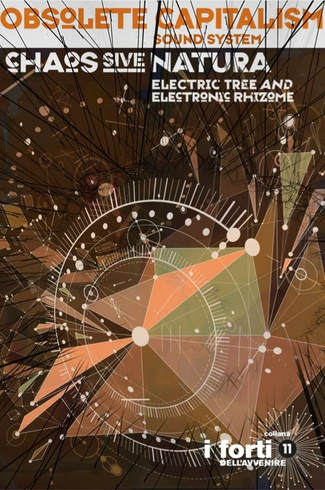
​This text will be presented on 20th, 21st, 22nd November 2017 at the 2nd International Conference on Deleuze and Artistic Research [Aberrant Nuptials] at Orpheus Institute in Ghent (Belgium) and will accompany the album “Chaos Sive Natura” (2017) by Obsolete Capitalism Sound System for the label Rizosfera / Nukfm.

CHAOS SIVE NATURA   
Electric Tree and Electronic Rhizome

by Obsolete Capitalism Sound System
“Me thought I saw one of an exceeding great stature, and an infinite greatness call me by my name, and say unto me, “What wouldest thou Hear and See? or what wouldest thou Understand, to Learn, and Know!” 1
​(Poemander, Hermes Trismegistus)
“I would say that for Spinoza there is a continuous variation —and this is what it means to exist— of the force of existing or of the power of acting”
​(Deleuze, Cours Vincennes - Lecture, Transcriptions on Spinoza’s concept of affect -24/1/1978)2
The present work does not have a starting point but many starting points, centres of strength and lines of movement that compose it. One of the dynamic points is shown by the title: Chaos Sive Natura. It is a Nietzschean paraphrase of an expression by Spinoza, Deus Sive Natura, God thus Nature, in his main work Ethica more geometrico demonstrata. For Spinoza, Nature is theophanic3: God is immanent to nature. Nietzsche, who considered Spinoza a forerunner4 of his philosophy, radicalizes the formula of equality between nature and deity5 with a more sinister expression, Chaos Sive Natura. Such a variation and removal occurred in 1881 in Sils-Maria in the same period when Nietzsche wrote of himself “I am one of those machines which can explode”6 and at the same time when, crying and singing of joy, he created the concept of Eternal Recurrence. The development of the concept that lies in Chaos sive Natura is unexpectedly not present in books like The Gay Science or in Thus Spoke Zarathustra, respectively published in 1882 and 1883. We find it instead in an unpublished notebook about the preparatory and narrative development of the concept of Eternal Recurrence. The notebook is known as M-III-1 and it was written in the summer of the year 1881, later collected in Colli & Montinari Italian edition of Unpublished Notes  or Posthumous Fragments as fragment 11 [195] e 11 [ 197 ].7
​The conceptual and argumentative development of the Eternal Recurrence has an eloquent title: Outlining of a new way of living and it is divided into four books by Nietzsche: 
“First Book: in the style of the first part of Ninth Symphony. Chaos sive Natura: on the dehumanization of Nature. Prometheus is chained on Caucasus. Write with Κράτος cruelty, thus “power”.
Second Book: Fast, skeptical, Mephistophelian. “On the assimilation of experiences”. Knowledge = a mistake that becomes organic and organizes. 

Third Book: A deepest passion and a hyperuranic sublimity are here together expressed for the very first time: “On the happiness of the lonesome” - he is the one that once was «part of the others» and has now reached the peak of independence: the perfect ego; only now such an ego can feel love, because  in the phases that do not reach the top of loneliness and self-domain, something different from love lies.
Fourth Book: dithyrambic breath. «Annulus æternitatis». Desire of living it all, once more and infinite times.
The incessant transformation - in a short time you have to pass through many individuals. The means is the incessant fight.”8
Spinoza deified Natura, substantia aeterna, attributing it a «celestial» status where God represents its most secret principle. On the contrary Nietzsche’s will is to de-deify and de-humanize it, freeing it from our «world» and making it a shapeless, aimless and ever-becoming Nature. He affirms in his The Gay Science: ”The total character of the world, by contrast, is for all eternity chaos, not in the sense of a lack of necessity but of a lack of order, organization, form, beauty, wisdom, and whatever else our aesthetic anthropomorphisms are called.”9 Both Spinoza and Nietzsche are «affirmative philosophers» of life as well as deniers of the moral order of the world, of the personality of God and of that «final aim», resulting from a time and divine-paced progressive action.
Speaking of an indifferent and immoral God, as a result of his own and Spinoza’s theories (respectively Eternal Recurrence and radical pantheism), Nietzsche asks himself:
“Does it make sense to conceive of a God ‘beyond good and evil’? Would a pantheism in this sense be possible? If we remove the idea of purpose from the process do we nevertheless affirm the process? - This would be the case if something within that process were achieved at every moment of it - and always the same thing. Spinoza attained an affirmative stance like this insofar as every moment has a logical necessity: and with his fundamental instinct for logic he felt a sense of triumph about the world’s being constituted thus”. (Fr. 7[71]) (2003: 118)10
Denying the final aim of the «process» or beheading it, is the first post that associates Spinoza, Nietzsche, Deleuze and Guattari’s Anti-Oedipus with the work Chaos Sive Natura, metaphorically defined  as an «acephalic» project.

What is particularly special and appropriate to our ends, is the recall of Beethoven’s ninth symphony by Nietzsche to better outline the tone in his first book Outlining of a new way of living. Here he finds a sonic parallelism with the first movement of the symphony, Allegro ma non troppo, un poco maestoso. Nietzsche, musician himself, with wishful compositional ambitions, fervent supporter and later denigrator of Wagner, often conceives concepts in musical terms. Chaos Sive Natura then needs a tempestuous, unbridled and majestic tonality like Be ethoven’s first movement of the Ninth Symphony. Its structure in fact is a sonic architecture where the variations of the themes, the polyrhythmic solutions, the overtures with clustered themes, the counterpoints and the musical figures chasing one another, all produce an impetuous and heroic lacerating movement. What Nietzsche finds particularly close to his own concept of Chaos are the constant opening and closing of the musical thematic groups, where no one dominates the others so that the formal moment of the first movement is represented by the indeterminateness of the sonic plans as they enter the symphony.

The fact that Nietzsche’s chaotic spatialization is similar to Beethoven’s, clearly shows up when we ask ourselves What is Chaos for Nietzsche? It is an abyssal continuum which moves per motu proprio and that has been freed from divinity, order and aims: an inscrutable «ring» spinning around without a centre and where all dynamic peripheries represent lines of energy in a never ending metamorphosis. Pure blurry nature. In the first movement there is a chaotic incipit represented by the imitation of the tuning of the musical instruments in the interval of the initial chord. This «technique» enables Allegro ma non troppo to express a sonic undetermined which recalls the chaotic, primordial, indistinct limbo of Nature. 
Nietzsche’s topological and ontological indetermination of his idea of a chaotic continuum may be compared to the feeling of uncertainty that Beethoven conveys through the wild blurry and dissonant musical outcomes of his first movement. The «head» of the musical theme of the first movement has melted in a plurality of combined sonic plans. With relevance Nietzsche will write in his aphorism n°109, inspired to the concept of Chaos sive Natura, that the chaos “must never be called an [anthropic] melody”11 because as Messiaen says, “music is not the privilege of human beings: the universe and the cosmos are made by refrains”12. The sonic theme of Chaos, far from being solely a harmonious link to human realm, passes through Nature as an escaping force from the nets men have arranged for it. The problem will be then how to make an alliance with the powerful chaos forces, disputing men’s «false privilege» and reaching the place where the «big universal noise» - in opposition to Boethius’ musica mundana - clashes with the micro-noise singularities of the contemporary and future machines of men.
An important question for the relationship between music and chaos is the one that Nietzsche poses in his fragment n°84 in The Gay Science: 
"In short: was there anything more useful than rhythm to the old superstitious type of human being?"13
In fragment 84 Nietzsche lists the reasons why ancient people, in particular the Greeks, invented and used «rhythm» in poetry, music, dance, assembling the various artistic expressions in only one act. The German philosopher talks of «superstitious utility» because the integration of the rhythm in the speech “reorganizes all the atoms of a sentence, bids one to select one’s words and gives thoughts a new colour and makes them darker, stranger, more distant.”14 Hence the paradox: what is today considered «useless», we mean poetry, was at those ancient times of a great importance, because the verse was better remembered than ordinary, practical and straightforward speech, especially for anthropomorphic gods of ancient times. “The rhythmic discourse was supposed to make a human request impress the gods more deeply.”15 This suggests the superstitious nature Nietzsche confers to the utility of poetry in its origin. The philosopher adds: “one wanted to take advantage of that elemental overpowering force that humans experience in themselves when listening to music: rhythm is a compulsion it engenders an unconquerable desire to yield, to join in; not only the stride of the feet but also the soul itself gives in to the beat - probably also, one inferred, the souls of the gods! By means of rhythm one thus tried to compel them and to exercise a power over them: one cast poetry around them like a magical snare.”16
Nietzsche does not simply offer the description of the role of coercion of the rhythm. Even before the Pythagoreans built the philosophical theory about the educational contrivance of poetry, the German philosopher writes that “one acknowledged music to have the power to discharge the emotions, to cleanse the soul, to soothe the «ferocia animi» - and indeed precisely  through its rhythmic quality. When one had lost the proper tension and harmony of the soul, one had to dance to the beat of the singer”17

Such a therapeutic power of the music was possible when “one began by driving the giddiness and exuberance of their passions to their peak, that is, one drove the madman wild, made the vindictive person drunk with lust for revenge. All orgiastic cults wanted to discharge the ferocia of some deity all at once and turn it into an orgy so that the deity would feel freer and calmer afterwards and leave man in peace.”18
Music is a form of taming and pacification both in cult and profane field,  exerting a «magic» force on those who are tired from work. Nietzsche brings the examples of the trireme in 6th and 5th b.c. century, rowing people who followed the rhythm given by the figure of the aulete, a flute player on the Attic war ships. The philosopher says that for each finished action a good reason to sing is always present because “... whenever one acts, one has an occasion to sing - every action is tied to the assistance of spirits: incantation and conjuration seem to be the primordial form of poetry.”19 When we consider, Nietzsche explains, that the invention of the hexameter has been attributed to the Delphi Oracle tradition, we can easily understand that the intention was to «conquer» the specific God, in this case Apollo: “The way the formula is pronounced, with literal and rhythmic precision, is how it binds the future; the formula, however, is the invention of Apollo, who as god of rhythm can also bind the goddesses of fate.”20
To be able to bind the future and therefore the god of rhythm, it is necessary to give some metric form to the poetic and musical discourse. Without verse/rhythm we are nothing and are left at the mercy of the future, on the contrary with verse/ rhythm we may be quasi-gods and are able to force our future. This can happen with any verse, bar or passage, because as Nietzsche says “even the wisest of us occasionally becomes a fool for rhythm, if only insofar as he feels a thought to be truer when it has a metric form and presents itself with a divine hop, skip, and jump.”21
“Feeling to be truer” through the rhythm, “subverting” the future through a “peculiar, magic cadence” able to alter its essence, is another aspect that links Spinoza, Nietzsche’s incessant transformation, the god of rhythms, with the acephalous project of Chaos Sive Natura.
Another centre of forces that enter our sonic-ship leaves from a flourishing electronic laboratory of our times called Electric Tree. It is an abstract jazz unit which includes in its free style composition, electronic improvisation. Composed by Franco D’Andrea (piano), Andrea Ayassot (saxophone), Luca Roccatagliati (electronics), the trio is grounded on D’Andrea’s figure, a cultured sensitive musician with a huge intellectual curiosity. He has been an icon of European Jazz since his first experimentation with Perigeo in the 70’s, to reach a more personal and intense style in between free jazz, blues motifs and recalls of Monk’s aphoristic phrasing. Ayassot is an imaginative saxophonist led by musical paths which cross European contemporary music, jazz and Indian ragas. Roccatagliati offers breakbeat experimentations that open to chaos forces, paving the way to abstract electronics, thanks to his peculiar rhythmic sensitivity, Latin and Jazz traces and a total dedication to Afro-futuristic bass culture. It is from Electric Tree laboratory that Obsolete Capitalism erratic lines set sail.22 
Whereas D’Andrea marks New Orleans as original fulcrum of jazz and meeting point of polyrhythmic sounds from central and western Africa with the harmonious Atlantic European experience, Obsolete Capitalism moves the focal point of the sound to an imaginative Jamaica, linking it to north-eastern African hypnotic acoustics, which suggest slow and deconstructed lines derived by dubbing practices of masters like King Tubby and Lee Scratch Perry. To the Atlantic Electric Tree, Obsolete Capitalism Sound System offers the electronic diasporic rhizome, thus molecularity of perpetual variations, dancing iridescent morphemes in electronic darkness. Deleuze writes: “Meter is dogmatic, but rhythm is critical.”23 O.C.S.S. is a”rhythmic dance” in the Nietzschean way of incessant form, of timbre intensity, but its concept of the “rhythm” is Deleuzian.

In A Thousand Plateaus Deleuze and Guattari introduce a concept of Rhythm different from Nietzsche’s. In the pages of Capitalism and Schizophrenia, the god of rhythms is substituted by the dreadful god of the Rhythm, the god of Chaos24. It is important to start from the idea of Chaos as introduced in A Thousand Plateaus, in particular in the chapter entitled 1837: 
On the refrain. Deleuze and Guattari describe it as follows: “Sometimes chaos is an immense black hole in which one endeavors to fix a fragile point as a center. Sometimes one organizes around that point a calm and stable “pace” (rather than a form): the black hole has become a home. Sometimes one grafts onto that pace a breakaway from the black hole. Paul Klee presented these three aspects, and their interlinkage, in a most profound way. He calls the black hole a”gray point” for pictorial reasons. The gray point starts out as nonlocalizable, nondimensional chaos, the force of chaos, a tangled bundle of aberrant lines.”25 ​
The «gray spatiality» is then indistinguishable, untraceable, a point-form cacophony and chaos a clot of forces crossing colossal abstractions. More radically, Deleuze and Guattari say: “Chaos is not the opposite of rhythm, but the milieu of all milieus” and “What chaos and rhythm have in common is the in-between—between two milieus, rhythm-chaos or the chaosmos”26

Hereby we witness an overturning in the concept of Rhythm as it has been acknowledged since ancient times. From a genealogical, anthropological and ontological point of view, Nietzsche identifies in the rhythm the poetic «compulsion» needed to open the sacred to the profane so to reach the cosmic forces of the future. Deleuze, on the other side, operates a cesura between the «rhythm» seen as the cadence of measure, and the «Rhythm». The Meter of the rhythm is a measure-rule imposed by men to decode any territory, while the pace of the Rhythm is a critic intrusion, an anomaly, a rhythmic singularity, a pure meeting-event among different milieus. Deleuze and Guattari write as follows: “It is well known that rhythm is not meter or cadence, even irregular meter or cadence: there is nothing less rhythmic than a military march (…) Meter, whether regular or not, assumes a coded form whose unit of measure may vary, but in a noncommunicating milieu, whereas rhythm is the Unequal or the Incommensurable that is always undergoing transcoding.”27 Through the above lines runs the echo of experiences marked by the «aleatory music» which strongly influenced XX century contemporary music of artists like Xenakis and Boulez. With an appreciation of Breakbeat science, originally derived from the afrodelic and diasporic tradition, and through the use of its pulsed rhythmic unit - the single beat, Obsolete Capitalism Sound System offers a possibility to overturn the codified rhythm. Dub and breakbeat techniques, sampling and turntablism variate the rhythm dissolving and reworking the metric code, distributing always renewed space-time blocks. ”Every milieu is coded, a code being defined by periodic repetition; but each code is in a perpetual state of transcoding or transduction (…) [the rhythm]  produce[s] a difference by which the milieu passes into another milieu.”28
In the wake of writers like Erik Davis, Kodwo Eshun, Steve Goodman, McKenzie Wark, Louis Chude-Sokei e Achim Szepanski29, Jamaican bass culture has become the great catalyzer of the music experimentation since ‘70s, through beats and remixes practices jammed with western urban black electronic experimentation. The polyrhythmic and polymetric vibratory of the afro-digital psychedelia subverts the reproducing measure: from King Tubby to Kool Herc, from Dillinja to Burial, the scheme of repetition with no variation is no longer present: milieus and rhythms re-appropriate their centrifugal force and take off to an imaginary Atlantic, creating an analogical and digital diaspora full of imaginative, utopian lines, fugues, back and forth returns30. In fact “rhythm is never on the same plane as that which has rhythm” being it New Orleans with its primordial jazz or Monk’s New York recalled by D’Andrea, Dillinja’s London or Russolo’s Milan. Deleuze will say: “…chang[ing] milieus, taking them as you find them: such is rhythm.”31 Landing, bifurcating, jumping as it happens with Underground Resistance’s afro-germanic sound of Detroit, Zulu Nation’s suburban Autobahn from New York, Kool Herc’s phantasmatic Jamaican vibes, Burial and Valve Sound System’s London, as well as D’Andrea’s rhythmic echoes of Monk’s New Yorker aphorisms. Everything vibrates “and all three at once: forces of chaos, terrestrial forces, cosmic forces: all of these confront each other and converge in the territorial refrain.” It is from the Chaos that Milieus emerge because “It is the difference that is rhythmic, not the repetition”. 32
If the spatialization of the milieu as theorized in Deleuze is no longer uniform because it postulates the non existence of an absolute space, than we can subvert the Cartesian philosophical coordinates that have been ruling our western world since XVII century. Starting from 1837: Of the Refrain the project Chaos Sive Natura tries to elaborate a path of musical transcoding because “a code is not content to take or receive components that are coded differently, and instead takes or receives fragments of a different code as such.”33  This happens for example in the first track entitled Bass Slight Swinging where the two bass-lines, reworked in Adrian Sherwood’s “rough” On U Sound style, mix with Klee’s slight swinging sails34 which lead the secret movement of the track, offering an oscillation between the sails and the bass in a precarious balance between Abstract and Figurative. The same «tres/passing» is present in D’Andrea Dancing Colors’ desert dub version, where the dancing colors of the desert turn into rhythms and spaces which intertwine with visual compositions of the most famous Italian colorist director, Michelangelo Antonioni in Zabriskie Point (1970). Particularly in the scene where the two protagonists, in a post-coitum suspension, are surrounded by the bright color of the improbable red cabins and by a shade of white-grey-pink colour of the alien mountains of the Death Valley, we discover Paul Klee’s indefinite gray point of his chaotic materic lines. To conclude the analysis of the rhythmic sequence-plane, we may consider the narrative development of La Machine Informatique dub where the fragment on the «computer machine» stated by Guattari in Vincennes (1975) about the impending algorithmic and computational reductionism of the data-economy, becomes a «sonic writing» thanks to a Jah Wobble-style bass-line which engages with Electric Tree’s abstractions and the soundtrack horns of Enemy (Villeneuve, 2013), a movie focused on the fascist pattern of  a «world order» in today societies of control. A composition inside a chaosmos is in other words the fragile sum of forms in a continuous transformation, of rhythmic paces and of «timbres», impossibile to be written in traditional music notation, being the unresolved, the challenge thrown by Roccatagliati’s electronic improvisation to Electric Tree’s abstract jazz.
If, according to Deleuze, the «territory» “is not a milieu, not even an additional milieu”, but “an act that affects milieus and rhythms, that «territorializes» them”35 what OCSS experiments with Chaos sive Natura is the mobile creation of a sonic surface, a chaotic plane where the space of the sound-to-come is changeable, deformable in n-dimensions until the creation of a n-sphere, a rhizosphere. Nature, thus Chaos, as music36. Among the possible thousand virtual ways of making a Refrain of a diverse thought work different, OCSS has chosen the Rhythm non-science, namely the non-orientable accelerationism, where the non-oriented acceleration of a sound no longer represents the rhythm that makes its velocity change - the derivative of velocity with regard to time - but the Rhythm which changes its milieu every time the sound «marks» the passage between a milieu and another, becoming in such a way the derivative of the milieu with regard to time.37 
A topological rhythm, a new topology of sound which accompanies in a randomly «chaotic» way the raise of the mutation between analogical and digital, between sonic and timbric planes, between the «becoming sound» of the Rhythm and the «becoming rhythm» of the sound, among sonic objects, between melodic landscapes and rhythmic characters. In short a chaos-interval which “becomes rhythm, not inexorably, but […which] has [always] a chance to”.38
Similarly, even Nietzsche’s fragment The Strong of the Future39, known as the “accelerationist fragment” so dear to accelerationists today, is «Rhythm», a rapid deafening change of milieu, or a fast scream40 to the homogenizing of the dwarfed species in industrial societies of any time. On such a Rhythmic edge, outlines a deep echo between the anti-mechanistic «process» of the revolutionary path, as expressed in Deleuze and Guattari’s Anti-Oedipus and the acephaly of Spinoza’ and Nietzsche’ s anti-deterministic «proces​s».41
Chaos sive Natura’s last definitive conceptual post is the Chaosmos event opposing the Cadence-Dogma, the eternal sacred «constraint» of the god of the rhythms. 
A sonic passage - hopefully not worse than those preceding it - implying obscurity of sounds, abysmal intensity, sonic intermittences taken to the limit of the rhizosphere:
non-orientable accelerationism.
Chaos Sive Natura: “Dance” to Chaos Rhythm! “Is that what you want?”42
​Coda: Barrel-organ song and little Recurrence43
“We can’t stand it anymore’, they shout, ‘stop, stop this raven-black music! Are we not surrounded by bright mid-morning? And by soft ground and green grass, the kingdom of the dance? Was there ever a better hour for gaiety? Who will sing us a song, a morning song, so sunny, so light, so full-fledged that it does not chase away the crickets but instead invites them to join in the singing and dancing? And even plain, rustic bagpipes would be better than the mysterious sounds, such bog-cries, voices from the crypt, and marmot whistles with which you have so far regaled us in your wilderness, my Mr. Hermit and Musician of the Future! No! Not such sounds! Let us rather strike up more pleasant, more joyous tones!”44

​Biography

​Obsolete Capitalism is a collective for pure independent research. Selfdefined as “gypsy scholars”, the collective deals with philosophy, art and politics. Obsolete Capitalism edited and published «Moneta, rivoluzione e filosofia dell’avvenire. Deleuze, Foucault, Guattari, Klossowski e la politica accelerazionista di Nietzsche» (OCFP, 2016), «Archeologia delle minoranze » (OCFP, 2015) and «Birth of Digital Populism» (OCFP, 2014). With Rizosfera publishing house, Obsolete Capitalism released «The Strong of the Future. Nietzsche’s Accelerationist Fragment in Deleuze and Guattari’s Anti-Oedipus» (Rizosfera/SF001), «Acceleration, Revolution and Money in Deleuze and Guattari’s Anti-OEdipus» (Rizosfera/SF002), «Deleuze and the Algorithm of the Revolution» (Rizosfera/SF004) and «Dromology, Bolidism and Marxist Accelerationism» (Rizosfera/SF009). It is also editor of the online blogs Obsolete Capitalism, Rizomatika and Variazioni foucaultiane. The collective has a sonic sub-unit under Obsolete Capitalism Sound System moniker: it has released «La machine informatique dub» (first 12 EP, Rizosfera/ NUKFM, 2016) and «Chaos Sive Natura» (first album, Rizosfera/NUKFM, 2017).
1 The Corpus Hermeticum of Hermes Trismegistus, The Second Book called Poemander, p.5, Blackmask Online, 2001, http://www.hermetics.org
2  Deleuze, Cours Vincennes - Lecture, Transcriptions on Spinoza’s concept of affect  24/1/1978 
 https://www.gold.ac.uk .
3  Baruch Spinoza: Ethics.
4 “I have a forerunner, and what  a forerunner!” Nietzsche’s letter to Overbeck 30th July 1881.Nietzsche reads Spinoza again in the summer 1881 in Sils-Maria thanks to the work of Kuno Fischer Geschichte der neuen Philosophie where the first volume - dated 1854 - is dedicated to Descartes’ philosophy and his «school». It is there that Spinoza is mentioned.
5   In his Ethics Spinoza theorized a distinction referring to nature: natura naturans and natura naturata. 
6  Letter to Gast 14th August 1881, Sils-Maria. Pierre Klossowski p. 55 Nietzsche and the Vicious Circle. Translated by Daniel W. Smith The University of Chicago Press.
7  Friedrich Nietzsche, Kritische Studienausgabe. Band 9. Nachgelassene Fragmente 18801882. Edited by Giorgio Colli and Mazzino Montinari. München and Berlin: Deutsche Taschenbücher Verlag and Walter de Gruyter,1988. 
8  Nietzsche, Nachlass  1881- 1882 , Fragment  11 [197]. 
9  Nietzsche, aphorism 109, entitled Let us beware! The Gay Science Book Three, p.109  Cambridge University Press, 2001. We noticed that in the third book of The Gay Science some “refrains” refer to the concept of Chaos sive Natura, in particular  from aphorism 109  to 113. Fragment 113 has been often quoted in Anti-Oedipus.
10  Nietzsche, Writings from the Late Notebooks. Trans. by Kate Sturge, Cambridge University Press, 2003.
11  Nietzsche, The Gay Science Book Three, p.109, Cambridge University Press, 2001.
12  G. Deleuze, F. Guattari: A Thousand Plateaus p. 309, University of Minnesota Press, 1987. The «coda» of the chapter entitled 1730: Becoming-Intense, Becoming-Animal, Becoming-Imperceptible is inspired to the «cosmic» musical Messiaen’s work and to that line where the becoming music of the chaotic sound and the becoming non musical sound of men, meets and clash.
13  Nietzsche, The Gay Science Book Two, p.85, Cambridge University Press, 2001.
14  Ibid.
15  Ibid., 84.
16  Ibid.
17  Ibid.
18  Ibid., 84-85.
19  Ibid., 84.
20  Ibid., 85.
21  ibid.
22  Obsolete Capitalism Sound System thanks Electric Tree for allowing the use of their sounds recorded at the live concert at Teatro Asioli in Correggio (Italy) on 22nd May 2015.  Later on Electric Tree has recorded a double CD, published by Parco della Musica Records in April 2016, entitled Trio Music vol. 1.
23  Deleuze and Guattari A Thousand Plateaus p. 313, University of Minnesota Press, Minneapolis, 1987.
24  This God of the Chaos-Rhythm, or Chaosmos, the vicious and abyssal god of the various orders of the disorder, looks at us smiling. He resembles Klossowski’s Baphomet - Prince of Modifications or Blanchot’s - The Laughter of Gods recalling Klossowski when saying “...when a god wanted to be the only God, all of the other gods were seized with uncontrollable laughters”. What possible relationship then between Apollo, god of the rhythms and safety and Chaosmos, god of Chaos-Rhythm and of infinite multiplicity?
25  Deleuze and Guattari A Thousand Plateaus, p. 312, University of Minnesota Press, Minneapolis, 1987
26 Ibid., 313 - Deleuze and Guattari consider each milieu as vibratory, a space-time block formed by the periodic repetition of the component.  
27  Ibid - On the transcoding of the rhythm, the musical expression “Afropean” by Electric Tree already represents a pure vibratory milieu. 
28  Ibid., 314 and 315.
29  Erik Davis, Roots and Wires, published in the volume edited by Dj Spooky Sound Unbound, MIT, 2008; Kodwo Eshun, More Brilliant Than the Sun, Quartet, 1998 (about to be republished by Verso Books, London in 2018); Steve Goodman (a.k.a. Kode 9), Sonic Warfare, MIT Press, 2009; McKenzie Wark, Black Accelerationism, Rizosfera, 2017; Louis Chude-Sokei, The Sound of Culture, W.U.P., 2016; Simon Reynolds and Katja Diefenbach: Mille Plateaux and Technodeleuze. Achim Szepanski’s Interviews (1994-1996), Rizosfera, 2017. We definitely agree with McKenzie Wark’s declaration in his Black Accelerationism: “But in many ways the original and best text on accelerationism was about Blackness – Kodwo Eshun’s More Brilliant Than the Sun” http://www.publicseminar.org 
30  Such a diasporic counter-culture has been described by Paul Gilroy in his The Black Atlantic (Harward University Press, March 1995) - See first chapter.  
31  Deleuze and Guattari A Thousand Plateaus p. 313, 314  University of Minnesota Press, Minneapolis, 1987.  In terms of «Rhythm and Chaos», Milan in the first years of XX century was very close to the big capitals of the Afro-American diaspora. Russolo’s manifesto The Art of Noises influenced European XX century music as well as jazz. The rhythmic encounter/clash between Russolo’s first noise sound period and Russian composer Stravinskij’s fury, is one of the main centre of forces that has influenced Chaos Sive Natura. Francesco Cangiullo (Futurist writer and painter) described an evening in Milan in Marinetti’s house (1914) when the Ballets Russes met the Italian noise music with Russolo and Pratella. “An acoustic resonator crackled with thousands of sparks as a fire creek. Stravinskij bolted emanating a hiss of joy and he stood up like a spring. A rastler rastled like silk skirts in winter or like young leaves in April…. The frantic composer pounced on the piano looking for an onomatopoeic extraordinary sound...while the dancer [Massine] moved his experienced legs… Diaghilev went like: Ah-ah-ah-ah, as a quail. That was his highest form of appreciation. By moving his legs the dancer wanted to show that the weird symphony was danceable” (from F. Cangiullo, Serate futuriste, Ceschina, 1961). 
32  Ibid., 314.
33  Deleuze and Guattari A Thousand Plateaus p. 314  University of Minnesota Press, Minneapolis, 1987.
34  Paul Klee, Sailing boats, gently moving, 1927.
35  Deleuze and Guattari A Thousand Plateaus p. 314  University of Minnesota Press, Minneapolis, 1987.
36   Chaos and Rhythm do not necessarily deal with the radical contemporary bruitisme but they both refer to the noise as a necessary heterogeneous compositional element.
37  Non-orientable accelerationism is a new branch of «topology applied to the sound». Under this aspect we define that the velocity of a sound is the rhythm with which it changes its position in the space, and that the acceleration of a sound is the rhythm with which it changes its velocity, while the non-orientable acceleration of a sound is the Rhythm with which it changes its milieu. Its sonologic law could affirm that a sonic mass times its non-orientable acceleration equals the chaotic force the mass is subjected to. It is probable that no differential equation may calculate the variable (a.k.a Rhythm). The continuous variation of all sonic components (plan of consistency) is then the direction non-orientable accelerationism tends to. 
38  Deleuze and Guattari A Thousand Plateaus p. 313  University of Minnesota Press, Minneapolis, 1987.
39  Nietzsche The Will of Power, Fragment n.898 - (9 [153] Colli-Montinari: Nietzsche’s Unpublished Writings from 1885 to 1888).
40 About “...strange configurations will arise instead in the widening cracks and blind spots of the megamachine as it proceeds deeper into its meltdown stage” read the enlightening essay by Edmund Berger published on Deterritorial Investigation Unit blog https://deterritorialinvestigations.wordpress.com 
41 We refer to the famous passage about «which revolutionary path» to take to subvert capitalism, expressed in Deleuze and Guattari’s Anti-OEdipus. This passage is defined as the «rhythmic moment» of the accelerationist philosophical movement today. 
42  Nietzsche, The Gay Science, Epilogue, Aphorism 383 p. 248  Cambridge University Press, 2001.
43  Nietzsche, Friedrich, Thus Spoke Zarathustra. Trans. by Adrian Del Caro, Cambridge University Press, 2006.
44  Nietzsche, The Gay Science, Epilogue, Fragment 383 p. 247-8, Cambridge University Press, 2001 - In the last two verses Nietzsche parodies the Fourth Movement in Beethoven’s Ninth Symphony. Beethoven in this movement will write “Oh friends, not such sounds! Let us rather strike up more pleasant, more joyous tones”. Wagner, who loved Ninth Symphony, directed it many times, and one time in Bayreuth in 1872 where Nietzsche was present. Beethoven’s incipit to Schiller’s “Ode to Joy” - a metron refusing Chaos in favour to a stellar future welcomed by a benevolent «lovely father» - could only be mocked by Nietzsche of The Gay Science. Nietzsche’s final passage of The Gay Science, entitled Epilogue, marks the Chaos philosopher’s definitive valediction from “Beethoven’s signature tune” used in any political horizon, which Deleuze rightly defined “potential fascism of music” (A Thousand Plateaus, Minnesota University Press, 1987 p. 348).

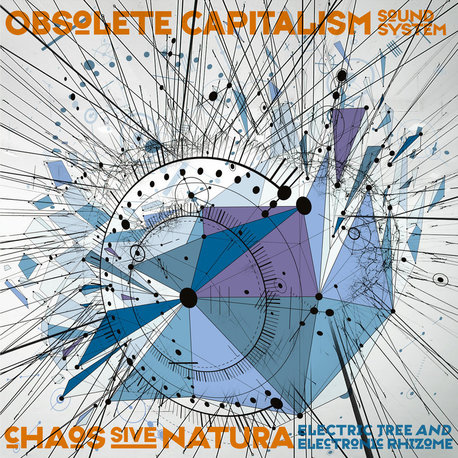
Chaos Sive Natura: Electric Tree and Electronic Rhizome 
​(Rizosfera/Nukfm, 2017) 
Tracklist

1.   Bass slight swinging  (Hommage à Paul Klee)
2.   Afro Abstraction (Xamaycan Funeral March remix)
3.   Notes for a quasi-living theory
4.   Rattling self-propeller
5.  Monodic (Dubmodic remix)
6.   Dancing colors (Zabriskie Point remix)
7.   Afecsana blues
8.  Irenica (Private Collection, R.E.)
9.  La machine informatique dub
Picture
Available on
​https://obsoletecapitalismsoundsystem.bandcamp.com/releases
Publishing House: Rizosfera - Series of Books - The Strong of the Future   
Anti-copyright, November 2017 Rizosfera  
​http://obsoletecapitalism.blogspot.it
0 Comments


Leave a Reply.

    A Brief History of Post-Metal
    A Brief Guide to the French Rave Revival
    Achim Szepanski - IMMANENT NON-MUSICOLOGY: DELEUZE/GUATTARI VS. LARUELLE
    ACHIM SZEPANSKI’S INTERVIEW (1994-1996) - TECHNODELEUZE AND MILLE PLATEAUX
    Achim Szepanski - MILLE PLATEAUX – ULTRABLACKNESS OF MUSIC
    Ben Frost
    Benjamin Noys - DEAD DETROIT LIES DREAMING: TECHNO (ANTI-) ACCELERATIONISM
    Berlin Atonal Festival - Documentary
    Carsten Nicolai – Spaces in Between
    CHRISTOPH COX - HOW DO YOU MAKE MUSIC A BODY WITHOUT ORGANS?
    Coil Manifesto
    Edmund Berger - SOUND HACKING: FURTHER REFLECTIONS ON NOISE AND NONCOMMUNICATION
    ÉLIANE RADIGUE
    Emir Kusturica & The No Smoking Orchestra
    George Winston - Creativity, Patience
    Geir Jenssen
    Gilles Deleuze and Felix Guattari - 'Becoming-Music'
    GSH- Interview
    Idrioema
    John Cage
    Joseph Nechvatal - MINÓY (part1)
    Joseph Nechvatal - MINÓY ​(Part 2)
    Joseph Nechvatal - MINÓY ​(Part 3)
    Joseph Nechvatal - MINÓY ​(Part 4)
    Joseph Nechvatal - MINÓY ​(Part 5)
    Kilian Jörg - ECOLOGICAL ART AND THE RESILIENCE OF MODERNISM
    Ø Mika Vainio
    Who is Maynard James Keenan?
    Ohal Grietzer
    Obsolete Capitalism Sound System - CHAOS SIVE NATURA (Electric Tree and Electronic Rhizome)
    Obsolete Capitalism - ROOTS AND WIRES
    Obsolete Capitalism - CALL FOR PAPERS: LA DELEUZIANA N. 10. RHYTHM, CHAOS AND NONPULSED MAN. TOWARDS A CHAOSMOTIC PHILOSOPHY.
    Obsolete Capitalism - Coversation with Adi Newton
    Porya Hatami - The Ambient Sound Art
    Pauline Oliveros – Big mother is watching you
    Selected Network Studies
    September Listings
    SCOTT WILSON and GUSTAVO DESSAL - Psychoanalysis and Music: A Resonance
    Steven Craig Hickman - Drone Music as Apocalypse
    Steven Craig Hickman - Techno-Futurism: Noise, Dissonance, and the Global Avante Garde
    The founding fathers of Ambient music
    Zafer Aracagök - NOISE ON NOISE

    Archives

    February 2019
    December 2018
    August 2018
    June 2018
    December 2017
    November 2017
    October 2017
    September 2017
    August 2017
    July 2017
    June 2017
    May 2017
    April 2017
    March 2017
    February 2017
    January 2017

    music  as particular art, musicmakers, music  critique, albums reviews ...

    All

    RSS Feed

Powered by Create your own unique website with customizable templates.
  • OnScenes
  • News
  • Art
    • Music >
      • Album Review
    • Poetry
    • Film >
      • Filmmakers >
        • Movies
    • Theater >
      • TheaterMakers
  • Philosophy
  • PhiloFiction
  • Science&Technology
  • Economy
  • Media
    • Video
    • Audio
  • About
  • Contact
    • Location