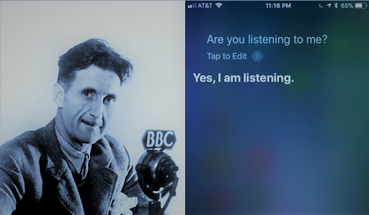
 Normalization—the mainstreaming of people and ideas previously banished from public life for good reason—has become the operative description of a massive societal shift toward something awful. Whether it’s puff pieces on neo-Nazis in major national newspapers or elected leaders who are also documented sexual predators, a good deal of work goes into making the previously unthinkable seem mundane or appealing. I try not to imagine too often where these things might lead, but one previously unthinkable scenario, the openly public mass surveillance apparatus of George Orwell’s 1984 has pretty much arrived, and has been thoroughly normalized and become both mundane and appealing. Networked cameras and microphones are installed throughout millions of homes, and millions of us carry them with us wherever we go. The twist is that we are the ones who installed them. As comic Keith Lowell Jensen remarked on Twitter a few years ago, “What Orwell failed to predict is that we’d buy the cameras ourselves, and that our biggest fear would be that nobody was watching.” By appealing to our basic human need for connection, to vanity, the desire for recognition, and the seemingly instinctual drive for convenience, technology companies have persuaded millions of people to actively surveille themselves and each other. They incessantly gather our data, as Tim Wu shows in The Attention Merchants, and as a byproduct have provided access to our private spaces to government agents and who-knows-who-else. Computers, smartphones, and "smart" devices can nearly all be hacked or commandeered. Former director of national intelligence James Clapper reported as much last year, telling the U.S. Senate that intelligence agencies might make extended use of consumer devices for government surveillance. Webcams and “other internet-connected cameras,” writes Eric Limer at Popular Mechanics, “such as security cams and high-tech baby monitors, are… notoriously insecure.” James Comey and Mark Zuckerberg both cover the cameras on their computers with tape. The problem is far from limited to cameras. “Any device that can respond to voice commands is, by its very nature, listening to you all the time.” Although we are assured that those devices only hear certain trigger words “the microphone is definitely on regardless” and “the extent to which this sort of audio is saved or shared is unclear.” (Recordings on an Amazon Echo are pending use as evidence in a murder trial in Arkansas.) Devices like headphones have even been turned into microphones, Limer notes, which means that speakers could be as well, and "Lipreading software is only getting more and more impressive." I type these words on a Siri-enabled Mac, an iPad lies nearby and an iPhone in my pocket… I won’t deny the appeal—or, for many, the necessity of connectivity. The always-on variety, with multiple devices responsible for controlling greater aspects of our lives may not be justifiable. Nonetheless, 2017 could “finally be the year of the smart home.” Sales of the iPhone X may not meet Apple’s expectations. But that could have more to do with price or poor reviews than with the creepy new facial recognition technology—a feature likely to remain part of later designs, and one that makes users much less likely to cover or otherwise disable their cameras. The thing is, we mostly know this, at least abstractly. Bland bulleted how-to guides make the problem seem so ordinary that it begins not to seem like a serious problem at all. As an indication of how mundane insecure networked technology has become in the consumer market, major publications routinely run articles offering helpful tips on how “stop your smart gadgets from ‘spying’ on you” and “how to keep your smart TV from spying on you.” Your TV may be watching you. Your smartphone may be watching you. Your refrigerator may be watching you. Your thermostat is most definitely watching you. Yes, the situation isn't strictly Orwellian: Oceana's constantly surveilled citizens did not comparison shop, purchase, and customize their own devices voluntarily. (It's not strictly Foucauldian either, but has its close resemblances.) Yet in proper Orwellian doublespeak, "spying" might have a very flexible definition depending on who is on the other end. We might stop "spying" by enabling or disabling certain features, but we might not stop "spying," if you know what I mean. So who is watching? CIA documents released by a certain unsavory organization show that the Agency might be, as the BBC segment at the top reports. As might any number of other interested parties from data-hoarding corporate bots to tech-savvy voyeurs looking to get off on your candid moments. We might assume that someone could have access at any time, even if we use the privacy controls. That so many people have become dependent on their devices, and will increasingly become so in the future, makes the question of what to do about it a trickier proposition. via
0 Comments
Leave a Reply. |
Science&TechnologyArchives
March 2020
|
 RSS Feed
